
Horace Grant was an educational writer, an official of the East India Company and a close friend and colleague of the philosopher John Stuart Mill. For more than twenty years, he was associated with Fairseat, where he built The Cottage, now known as Court House, and was closely involved with the establishment of the girls’ boarding school at Fairseat House.
Grant was born in December 1799. His father was Andrew Grant and his mother Mary Maullin. Through the Grant and Maullin families, he was related to several people who later became closely associated with Fairseat, including Hannah Grant, who ran the boarding school at Fairseat House.
East India House and John Stuart Mill
Grant spent much of his working life at East India House in London, the headquarters of the East India Company. From 1826 until 1845, he worked in the Examiner’s Office alongside John Stuart Mill, who would become one of the leading philosophers and political thinkers of the nineteenth century.
Grant was more than simply one of Mill’s office colleagues. He took part in Mill’s intellectual and debating circles and accompanied him on walking tours in 1827 and 1828. Their friendship continued long after Grant left the East India Company.
From 1837 to 1845, Grant held one of the special clerkships in the Correspondence Branch. The work of the Examiner’s Office involved preparing and examining the extensive correspondence through which the East India Company governed its territories in India.
The description of Grant on his memorial at Stansted as “late of the East India House” reveals a much more interesting story. For almost twenty years he worked alongside one of Victorian Britain’s most important thinkers and was part of John Stuart Mill’s close intellectual circle.
An Educational Reformer
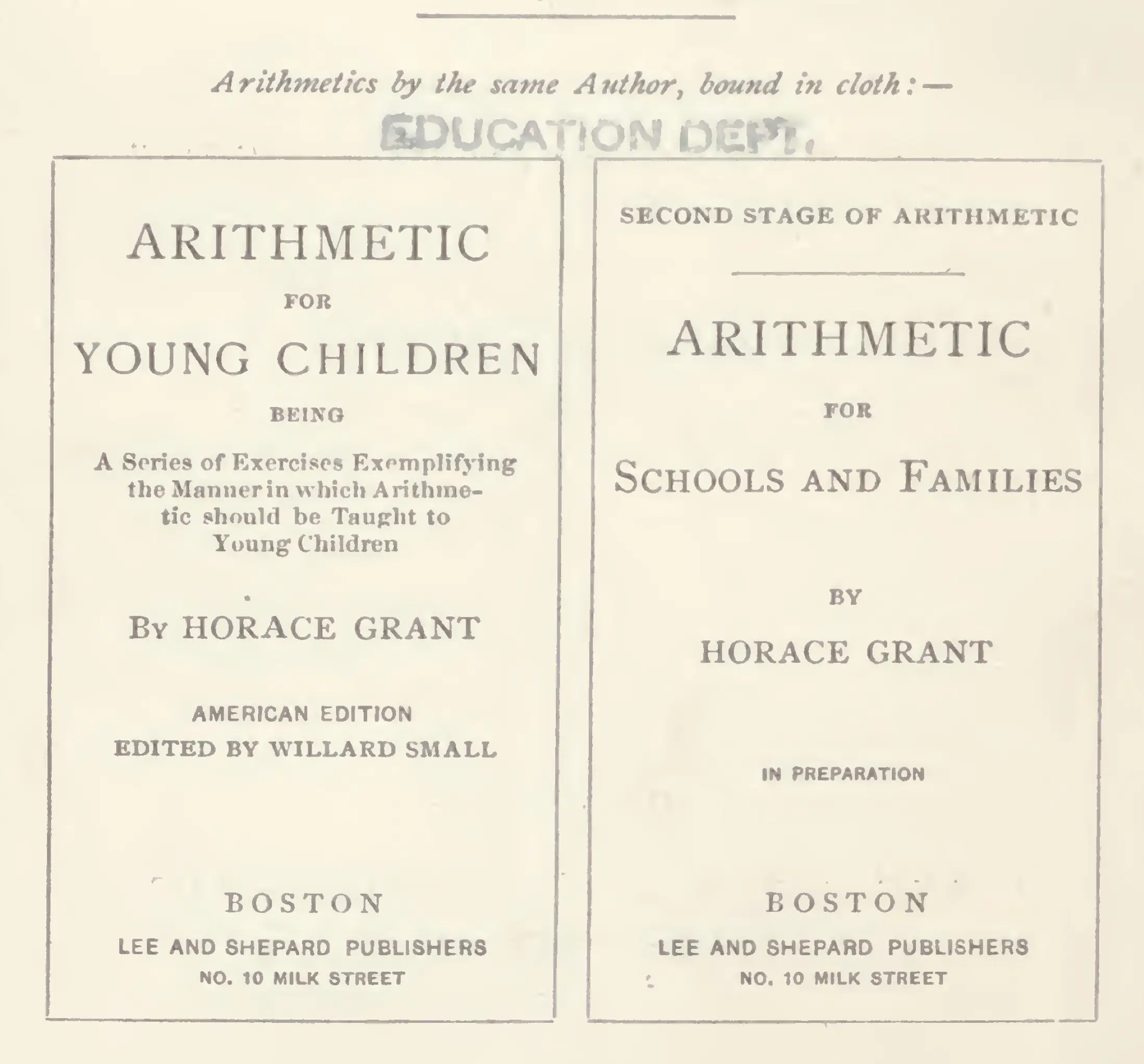
Grant also developed a strong interest in education, particularly in methods of teaching young children.
Among his published works were Arithmetic for Young Children, Drawing for Young Children, Geography for Young Children, Geometry for Children, Elements of Practical Geometry for Schools and Workmen and Exercises for the Improvement of the Senses. His approach was progressive for its time. Rather than simply requiring children to memorise facts and answers, Grant encouraged them to observe, reason and discover things for themselves.
John Stuart Mill reviewed two of Grant’s books in 1835 — Arithmetic for Young Children and Exercises for the Improvement of the Senses — and praised this approach to teaching. Grant’s work was associated with the educational ideas of the Swiss reformer Johann Heinrich Pestalozzi, who advocated learning through observation and practical experience rather than rote instruction.
Horace Grant and Fairseat
Grant’s connection with Fairseat developed during the 1830s. In 1839, William Hickson of Fairseat Manor sold land to Horace Grant where he built Fairseat House and a smaller residence nearby known as the Cottage (now Court House).
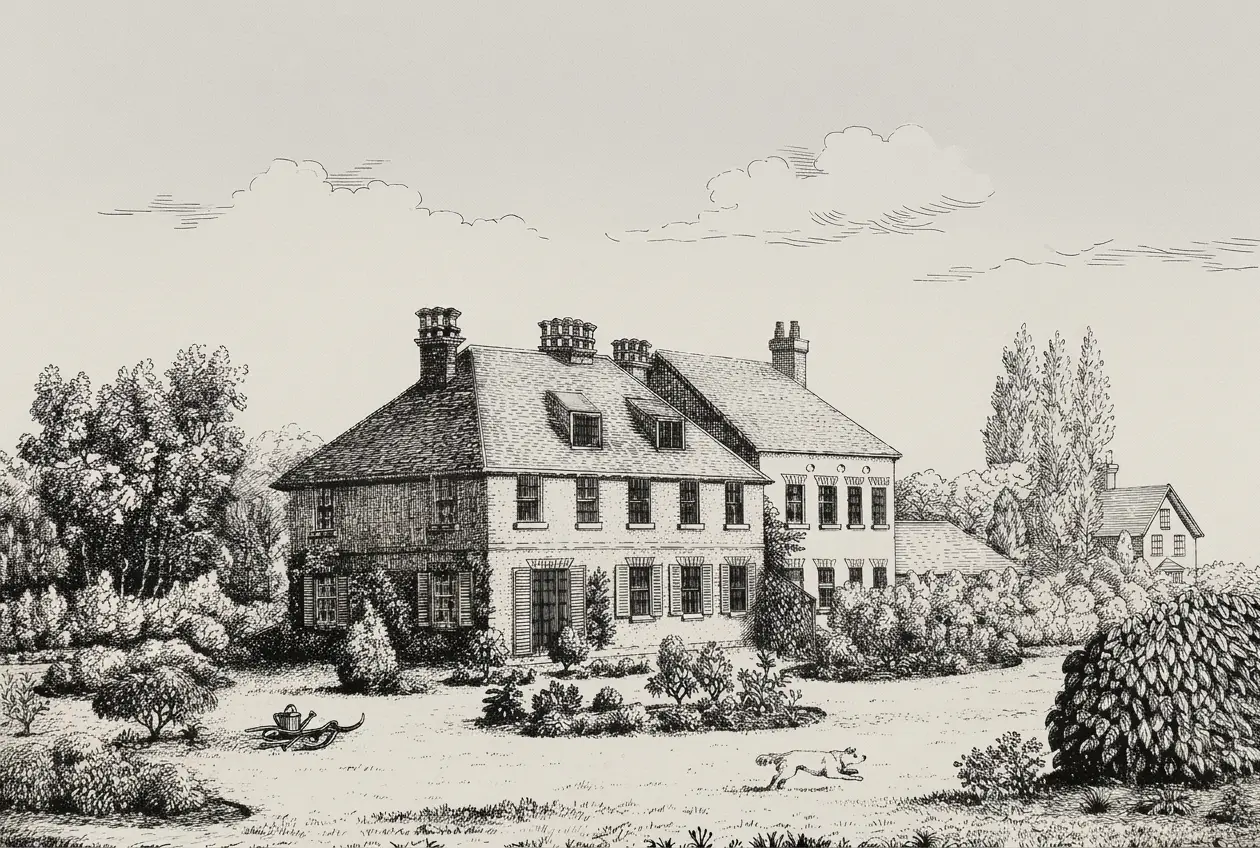
Fairseat House was used as a boarding school for young ladies and was run by Grant’s cousin, Hannah Grant. The school became a substantial establishment. By 1841 there were 52 pupils, four teachers and four domestic staff living there.
Grant himself lived nearby at The Cottage. The house survives today, although enlarged and renamed Court House. There is particularly good evidence that Grant was responsible for building it. In his will of 1862, William Edward Hickson left ten guineas to the owner of the Cottage at Fairseat, specifically describing it as the cottage “built by my late friend Horace Grant.”
Note: Further information on Fairseat House and the Cottage is available in the ‘Places’ section of the website.
Grant’s own interest in progressive education makes his involvement in the creation of a purpose-built school at Fairseat particularly appropriate. Although there is no evidence that his educational books were formally used at Hannah Grant’s school, his ideas provide an interesting background to its establishment.
Life at Fairseat.
By the middle of the nineteenth century, Grant was firmly established as one of Fairseat’s small group of prominent residents. Melville’s 1858 Directory of Kentish Villages listed just four inhabitants of the parish as “Gentry”. They were Mrs Goldicutt, William Edward Hickson of Fairseat Manor, Edward Partridge and Horace Grant Esq.
Grant continued his friendship with John Stuart Mill. A surviving letter from 1839 shows that Grant was trusted with Mill’s papers, while their later correspondence demonstrates that the friendship endured for many years.
Early in 1859 Grant became seriously ill with pulmonary disease and suffered a haemorrhage. On 4 March Mill wrote personally to his old friend concerning his illness and thanking him for newspapers that Grant had sent him.
Horace Grant died at Fairseat on 29 March 1859, aged 59. Mill had intended to attend his funeral at Fairseat but was prevented from doing so. His correspondence concerning Grant provides unusually personal evidence of the friendship between the two men.
Memorial to Horace Grant
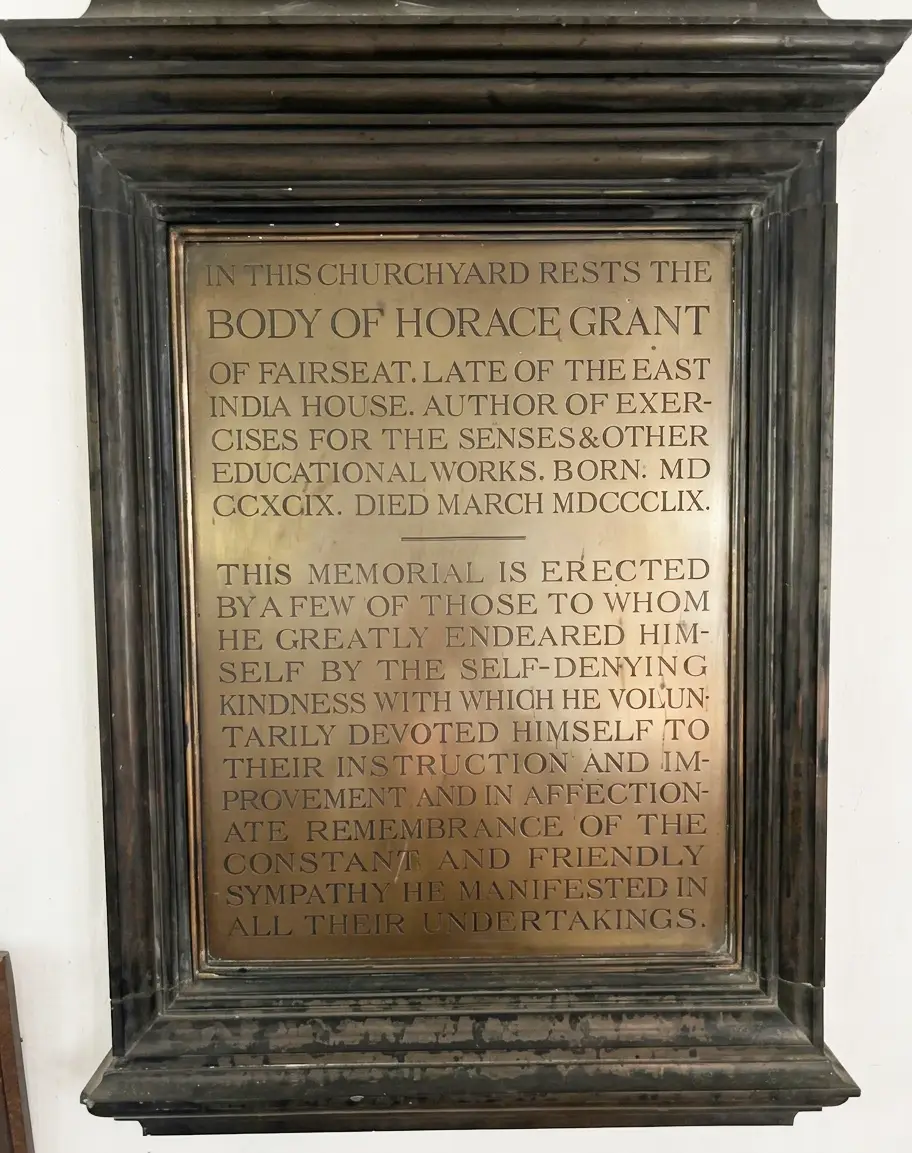
Grant is buried in the churchyard of St Mary the Virgin at Stansted. A brass memorial records not only his life but something of the affection in which he was held:
“IN THIS CHURCHYARD RESTS THE BODY OF HORACE GRANT OF FAIRSEAT, LATE OF THE EAST INDIA HOUSE, AUTHOR OF EXERCISES FOR THE SENSES & OTHER EDUCATIONAL WORKS.”
More unusually, the remainder of the inscription explains why the memorial was erected. It was placed there by a few of those to whom Grant had greatly endeared himself through his “self-denying kindness” and the way in which he had voluntarily devoted himself to their “instruction and improvement”.
It also records the “constant and friendly sympathy” he had shown towards their undertakings. The wording gives us a rare glimpse of Grant as a person. The qualities remembered by those who knew him, education, encouragement, kindness and an interest in the improvement of others, accord closely with the principles expressed in his educational writing.
Grant’s memorial continued to attract interest after his death. On 16 August 1906, the local antiquarian Benjamin Harrison visited Stansted churchyard and transcribed the inscription in his journal.
A Remarkable Fairseat Resident
Horace Grant is now a largely forgotten figure, but his life connected the small Kent village of Fairseat with a much wider nineteenth-century intellectual world. He spent almost twenty years working with John Stuart Mill at the East India House and became one of Mill’s friends and intellectual companions. He wrote books advocating progressive methods of educating children and helped establish a school at Fairseat which educated generations of young women.
His most visible legacy in the village survives in the buildings he created. Fairseat House remains one of the village’s most prominent historic houses, while his own home, The Cottage, survives as Court House. Perhaps the best summary of Grant, however, remains the one left by those who actually knew him. His memorial at St Mary’s church does not celebrate wealth, rank or public office. Instead, it commemorates a man remembered for his kindness, his friendship and his willingness to devote his time to the education and improvement of others.