
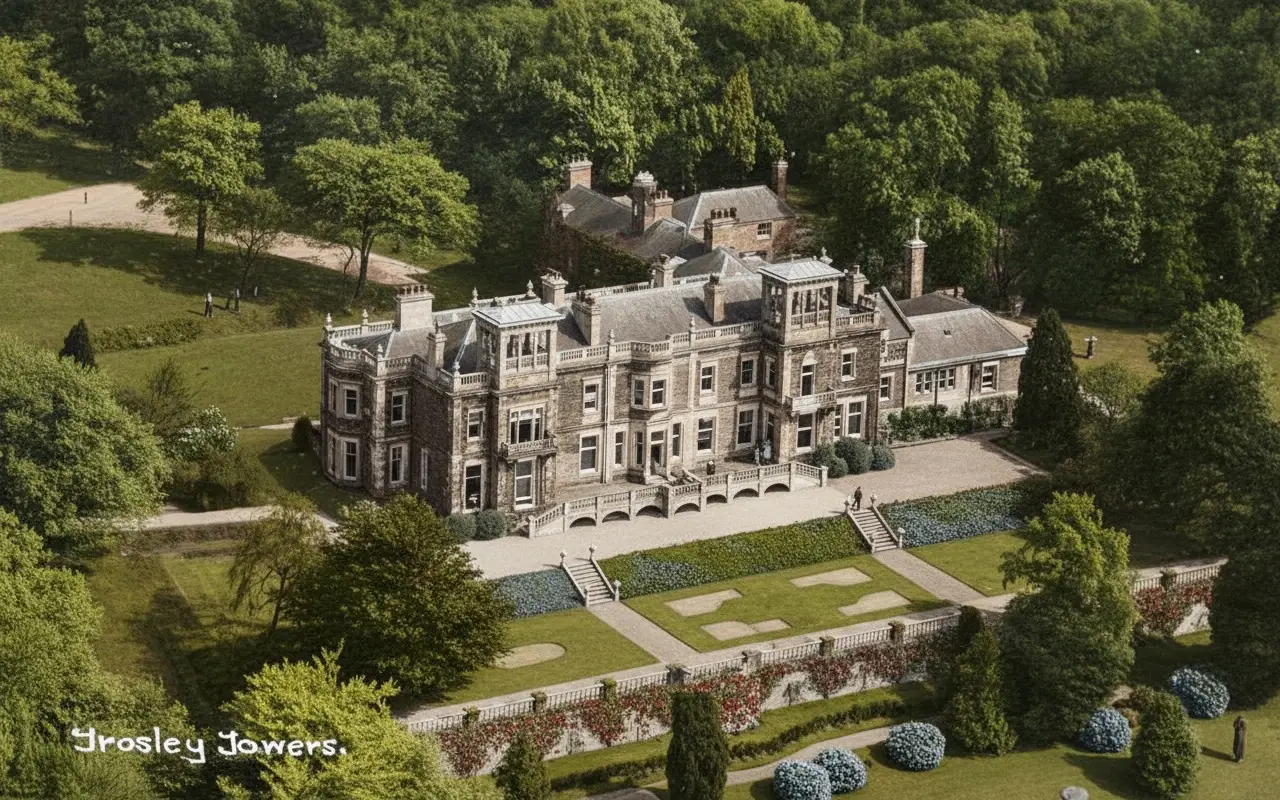

Sir Sydney Hedley Waterlow, 1st Baronet, KCVO (1822–1906) was a British philanthropist and Liberal Party politician, well known for donating Waterlow Park in Highgate, North London, to the public as ‘a garden for the gardenless’ and for building the country mansion ‘Trosley Towers’ between Fairseat and Trottiscliffe, in North West Kent.
The Waterlow family were among the wealthiest and most influential in the City of London during the Victorian and Edwardian eras. The earliest Waterlows found in England were refugees from the persecution of Protestants in northern France in 1628, and are mentioned in the marriage registers of a Protestant refugee society in Canterbury in 1633.
Sir Sydney had a substantial property and land in Highgate, North London, and following his marriage to Anna Maria Hickson in 1845, he named the Highgate property ‘Fairseat House’, after his wife’s family home in Fairseat in the parish of Stansted, Kent. Anna was the daughter of William Hickson [Snr], who lived at Fairseat Manor. She was the sister of William Hickson [Jnr], who was a prominent social reformer. An adjacent property on Highgate Hill, Hertford House, was occupied by William Hickson’s family from 1850, thereby cementing ties between the Waterlow and Hickson families in both Highgate, London, and Fairseat, Kent.
Sydney Waterlow was appointed to the office of Sheriff of London in 1866 and served as a juror for Great Britain at the International Exhibition of Paris the following year. His term was also notable for a banquet hosted for the Viceroy of Egypt at the Mansion House and for the City of London Corporation’s reception for Sultan Abdulaziz at Guildhall. Sydney was subsequently knighted on the 3rd August 1867 and was elected as Lord Mayor of London in 1872.
In the following years, Sir Sydney purchased additional land and properties in the Highgate area, eventually forming an estate of some 29 acres. In 1889, Sir Sydney made the generous and public-spirited decision to present the whole of his Highgate estate to the London County Council. The estate was renamed ‘Waterlow Park’ and exists as a thriving public amenity to the present day.
In the late 1870s, he purchased 376 acres of prime Kentish downland near his first wife’s family property in Fairseat, Kent. His wealth can be appreciated when it is realised that he did this without disposing of his Highgate assets. The estate was to the south of Fairseat and north of the village of Trottiscliffe and extended in an easterly direction towards Meopham, and towards Wrotham in the west.
Note: Further information on Sir Sydney Waterlow is available under ‘Luminaries’, within the ‘People’ section of this website.


Southerly view from the Trosley Estate towards Trottiscliffe village and the Weald of Kent.
Sir Sydney named the area ‘Trosley Estate’, after the neighbouring village of Trottiscliffe, which is locally pronounced as ‘Trosley’. The estate was approximately 700 feet above sea level on the North Downs and offered spectacular views over the villages of Trottiscliffe and Wrotham, and over the Weald of Kent towards the South Downs. It was on the Westerley portion of the estate where Sir Sydney was to build his extensive country mansion, ‘Trosley Towers’.
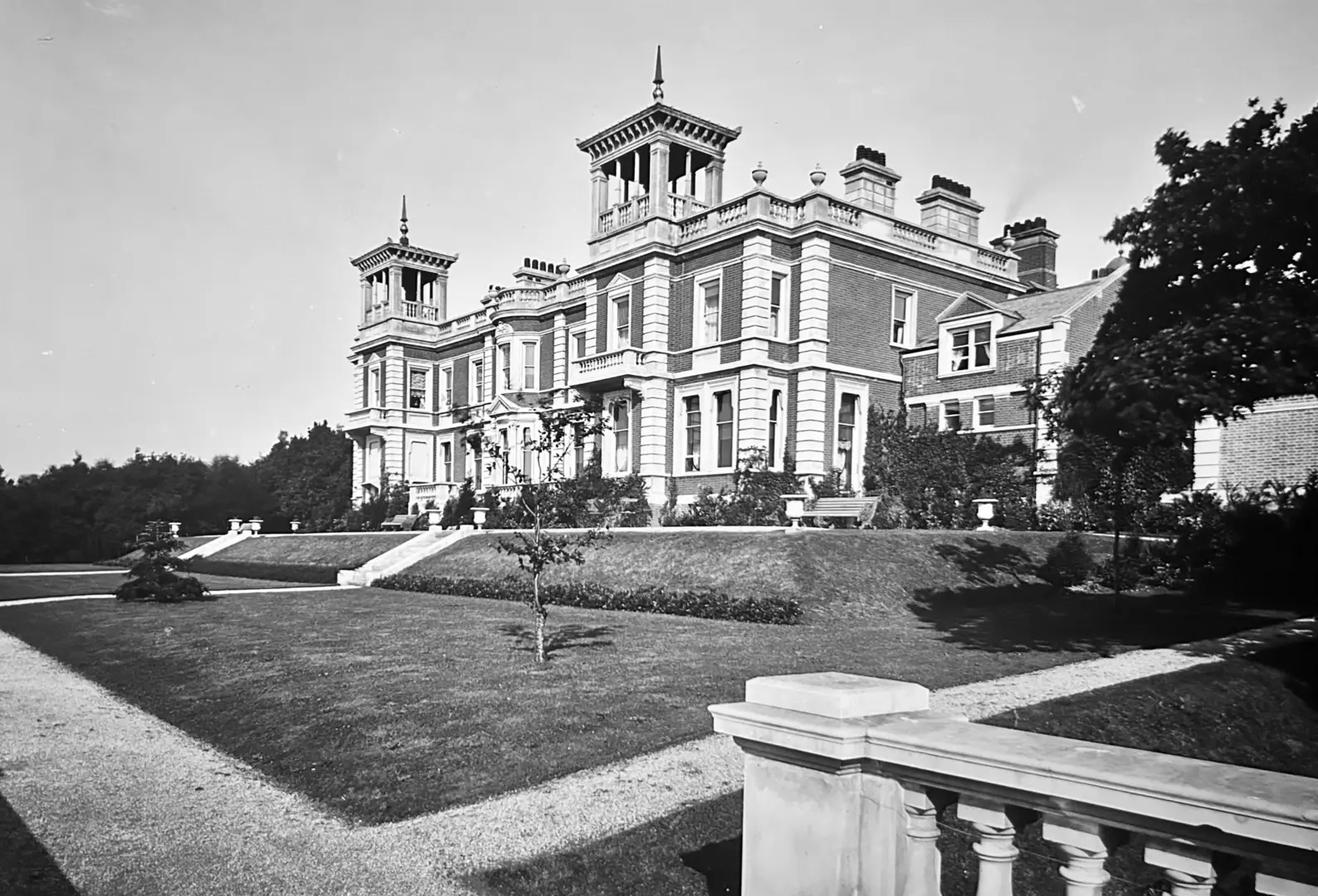
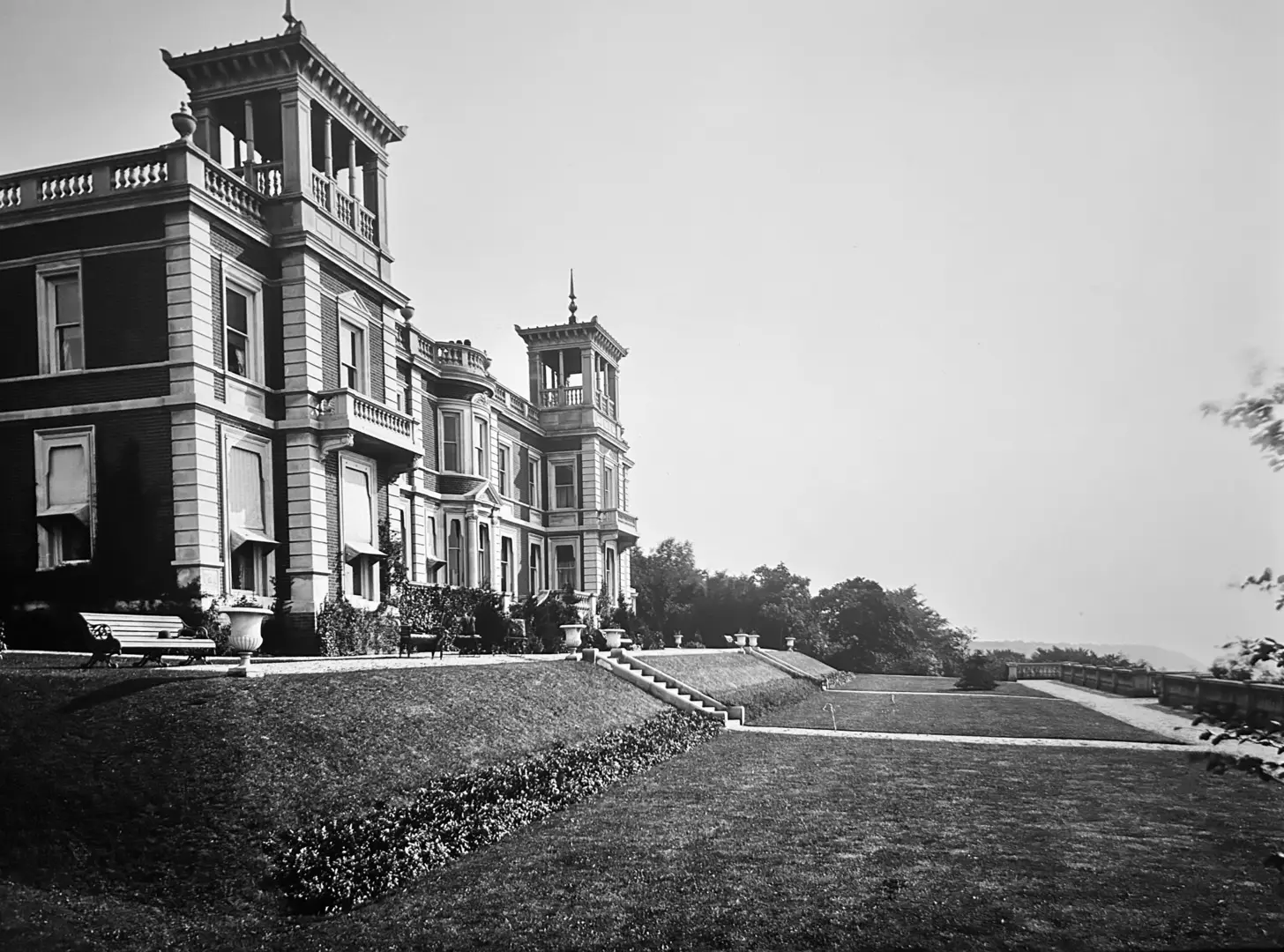
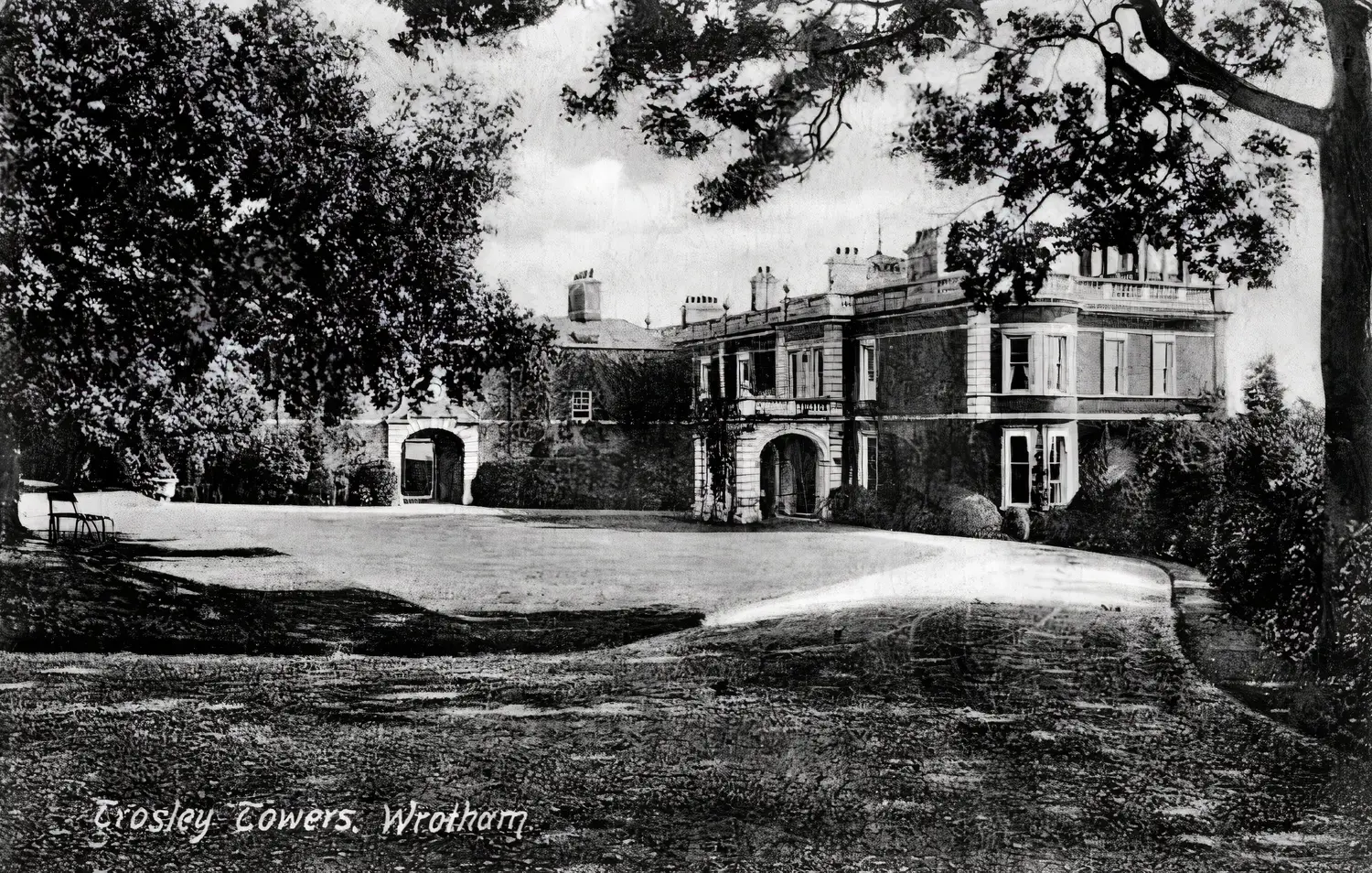
Sir Sydney commissioned the architect E R Robson to create the mansion house, Trosley Towers, on the crest of an escarpment on the North Downs, to the east of Trosley Hill above the Pilgrims Way. The location chosen was on a portion of the estate, to the west of Trosley Hill (now Vigo Hill). The mansion was built just inside the southern boundary of Stansted Parish, with the Trottiscliffe boundary running through the terrace on the south side of the main house.
Two tree-lined entrance drives provided access from the main Wrotham to Gravesend Road, with gatehouse lodges built at the drive entrances, one to the northeast and another to the southwest. The main drives are highlighted in yellow on the 1908 location map.
The northerly entrance was on the Gravesend road at the start of Harvel Road and ran in a south-westerly direction over a bridge across Trosley Hill (now Vigo Hill), and continued to join the circular main drive at the north entrance to the Trosley Towers mansion house. The bridge bears the Waterlow family crest, which is still visible today. The northern driveway entrance featured a gatehouse, now a residential property named North Lodge.
The gated southern drive also began on Gravesend Road, on the incline towards Wrotham, opposite farmland that would become McMillan House in the 1930s. McMillan House is an important local landmark adjacent to Platt Farm, named after Margaret McMillan, who dedicated her life to the developmental needs and educational progress of kindergarten and primary-age children.
Note: Further information on McMillan House is available under ‘Landmarks & Places of Interest’, within the ‘Places’ section of this website.
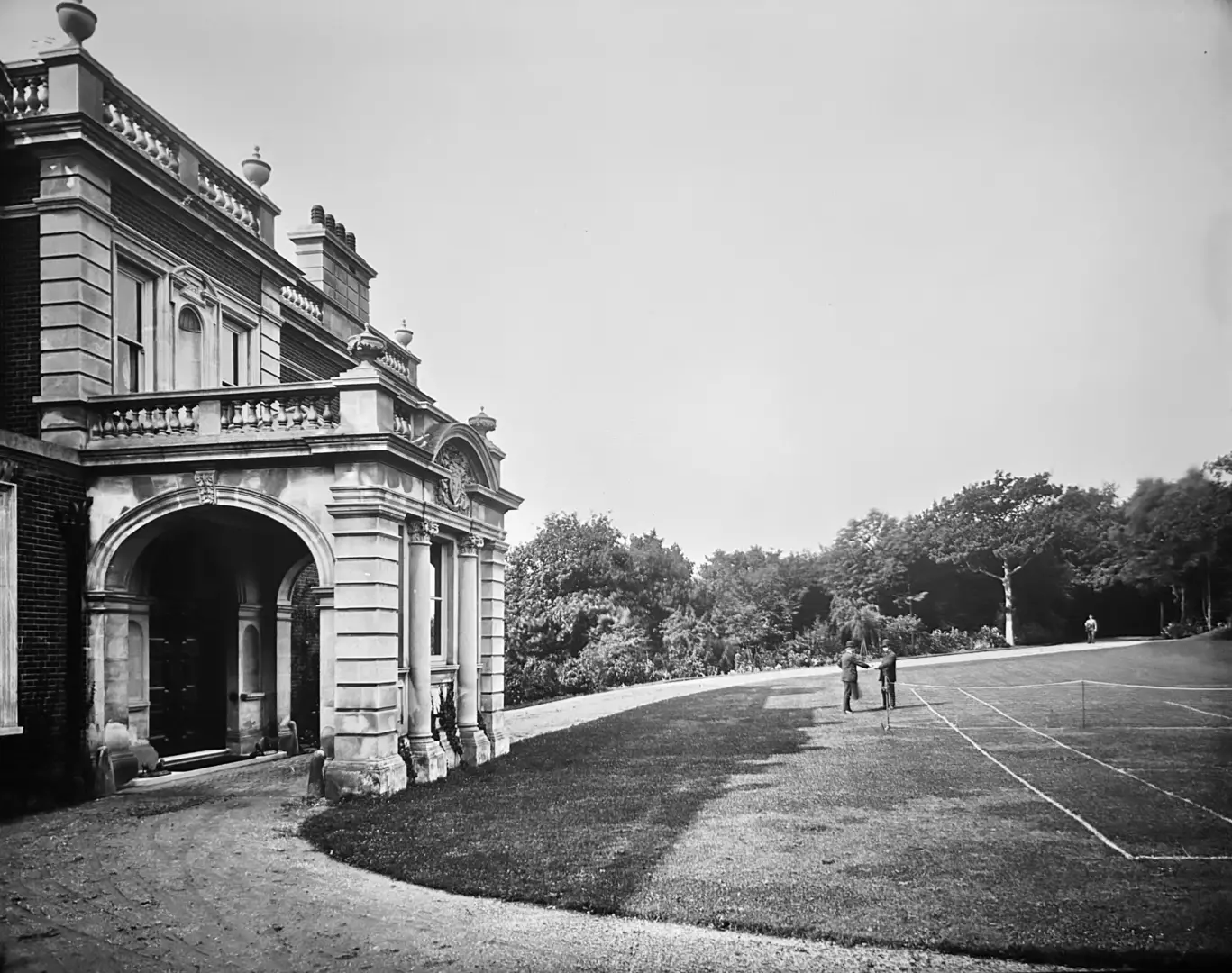
The southern gated entrance featured a lodge originally occupied by the Head Chauffeur, which still exists today as South Lodge, now a residential property. An avenue of chestnut trees ran eastwards from South Lodge to the junction with Hognore Lane, where the head gardener’s ‘Garden Lodge’ was situated. The driveway continued east to Trosley Towers. Both drives met at the mansion house by way of a circular drive, which surrounded the front lawn and passed under the mansion’s Porte Cochère. The central front lawn was marked out and used as a tennis court during the summer months.
Note: A Porte Cochère is a covered porch-like structure at a building’s main entrance, through which a horse-drawn carriage or motor vehicle can pass, providing arriving and departing occupants with protection from inclement weather.
An additional driveway from the top of Trosley Hill, opposite the original Vigo Inn, to the mansion house was added, along with an electrician’s shed, coachman’s cottage, carriage barn, and stables. This newer driveway is highlighted in green on the location map.

The 2026 satellite image includes a yellow overlay highlighting the original Trosley Towers Estate, which extended to some 376 acres and covered four local parishes: Stansted, Wrotham, Trottiscliffe, and Meopham. The Parish boundaries are shown as thin red lines on the satellite image. The Northern boundary was the main road between Wrotham and Gravesend, now the A227, and Harvel Road. A large proportion of the southern boundary followed the Pilgrims’ Way, the historical route taken by pilgrims from Winchester to the shrine of Thomas Becket at Canterbury. Locally, the Pilgrims Way runs through Otford, Kemsing and Wrotham, north of Trottiscliffe, towards Cuxton, where it crosses the River Medway.
The Northern boundary was the main road between Wrotham and Gravesend, now the A227, and Harvel Road. Parts of the southern boundary followed the Pilgrims’ Way, the historical route taken by pilgrims from Winchester to the shrine of Thomas Becket at Canterbury. Locally, the Pilgrims Way runs through Otford, Kemsing and Wrotham, north of Trottiscliffe, towards Cuxton, where it crosses the River Medway.
Sir Sidney made many improvements to the estate, and it is understood that he hoped to purchase additional land as far as Meopham with the intention of building a private road from Trosley Towers to Meopham Railway Station, but this was never completed. He did, however, build several properties on the estate, some of which remain today. Hamilton Lodge on Harvel Road was one such example.
Pilgrim House, at the bottom of Vigo Hill and dating back to 1590, was also part of the Trosley Towers Estate. The house and some 7 acres of land were later sold by Sir Sydney, and subsequent historical boundary maps show this area as not being included in the estate, which otherwise followed the Pilgrims Way. Pilgrim House was originally sold for around £600 in the late 19th century, and the most recent valuation was £1.75 million when the property last changed hands in 2017.

Millers Farm on the Gravesend Road was also originally part of the Trosley Towers Estate and included an oast house used for drying hops.
Note: An oast house consists of a rectangular one or two-storey building (the ‘stowage’) and one or more kilns in which the hops were spread out to be dried by hot air rising from a wood or charcoal fire below. The drying floors were thin and perforated to permit the heat to pass through and escape through a cowl in the roof, which turned with the wind. The freshly picked hops from the fields were raked in to dry, then raked out to cool before being bagged and sent to the brewery.
The earliest surviving oast house is at Golford, Cranbrook, near Tunbridge Wells. It dates to some time in the 17th century and closely mirrors the earliest documentary evidence of oasts, soon after the introduction of hops into England in the mid-16th century. Early oast houses were simply adapted barns, but by the 18th century, the distinctive tall buildings with conical roofs had been developed to increase air movement. At first, these were square, but around 1800, round kilns were developed in the belief that they were more efficient.
The oast house at Millers Farm was one of the first in Kent to be converted into a residence by Sir Philip Waterlow in 1903, and is thought to be unique for its ornate windows in the kiln roof. The windows have been replaced since the postcard view was taken, and sadly, the pinnacles on the gable above each window have been truncated, so the building has less of the air of a ‘Swiss pagoda on ecstasy’, as it was so memorably described by Headley and Meulenkamp in ‘Follies, Grottoes and Garden Buildings’ published in 1999.
The property was known as Tower Folly and, from 1960 to 2000, was home to Daphne Oram, well known for her involvement in establishing the original BBC Radiophonic Workshop. Following her time at the BBC, Daphne set up her own music studio at Tower Folly and is recognised as a pioneer of electronic music.
Note: Further information on Daphne Oram is available under ‘Luminaries’, within the ‘People’ section.

Sir Sydney commissioned the architect E R Robson to create the mansion house. Edward Robert Robson, FRIBA FSA FSI (1836 – 1917), was born in Durham, served an apprenticeship to Newcastle’s John Dobson and later worked with Sir George Gilbert Scott on restoring the tower of Durham Cathedral. He was an English architect famous for the progressive spirit of his state-funded school buildings in London during the 1870s and early 1880s. During his years with the School Board, Robson designed numerous schools in London. To this day, his schools remain in use and are known as ‘London School Board triple deckers’ due to their innovative design over three floors. They are significant public buildings, instantly recognised as masterpieces of their kind, and they have been described as ‘sermons in brick’. After leaving the Board in 1884, he remained as consulting architect to the Education Department. Robson was instrumental in designing new school structures, notably Primrose Hill Infants’ School (1896), the Cheltenham Ladies’ College (1896), and the Jews’ Free School in Spitalfields (1904).
Robson was also the architect of the Grade II listed ‘Queens Building’ in Tower Hamlets, London, with much of the funding provided by John Thomas Barber Beaumont, who, following his death in 1840, had left a sum of money to promote the education and entertainment of the people in the vicinity of Beaumont Square. The Queens Building was opened by Queen Victoria in May 1887, as an educational and cultural venue, and was also known as the ‘People’s Palace’. It is now part of Queen Mary University of London. Robson’s design style is evident in the similarities between the features of Trosley Towers and the Queens Building in the above photographs.
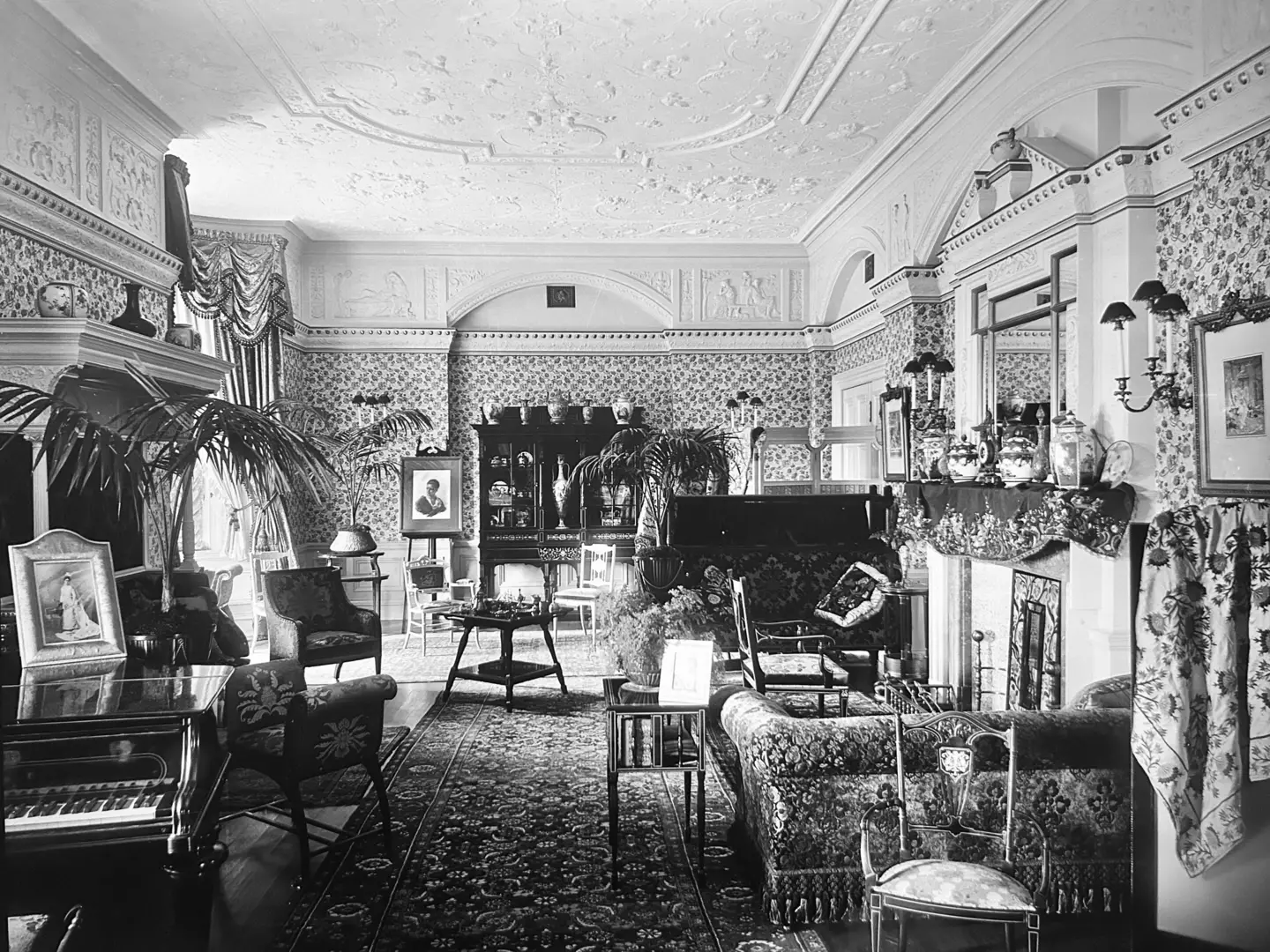
The mansion house consisted of an entrance and reception halls, a billiard room, three reception rooms, a study, twenty bedrooms and dressing rooms, four bathrooms and offices. The following details are from the sales agent’s guide for the 1932 auction, following Sir Philip Waterlow’s death.
Ground Floor
- Entrance Hall: 25 ft. by 17 ft. with massive doors of panelled oak and a floor of white, rouge and black marble. Off this Hall is a cloakroom.
- Drawing Room: An “L” shaped room 40 ft. by 30 ft. with the ceiling decorated by delicate mouldings, panelled walls and dado, open fireplace with white-tiled hearth, marble surround and beautiful moulded chimneypiece with a central panel of Amorini.
- Morning Room: 28 ft. 6 ins. by 18 ft., and featured a moulded cornice and steel fireplace surmounted by a chimneypiece moulded in Acanthus design, supported by Caryatides and with a central panel of Amorini.
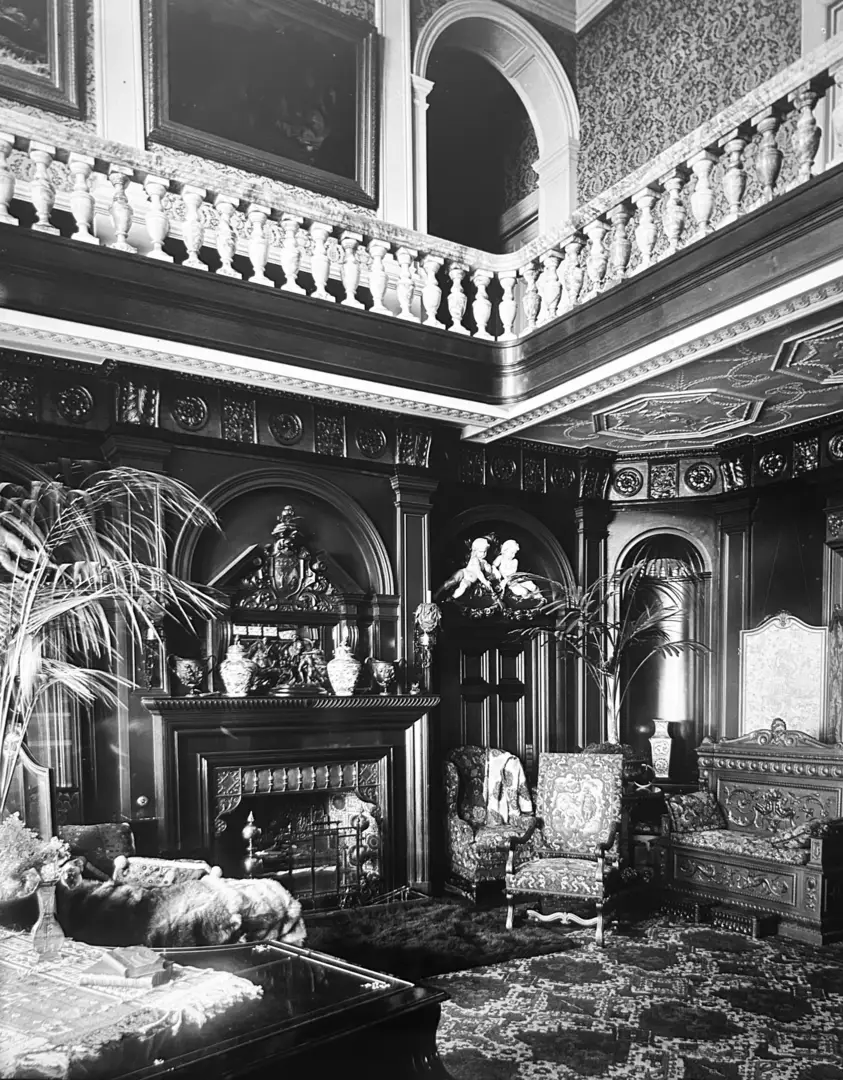
- Reception Hall or Lounge: 29 ft. square, with finely carved doors from the Entrance Hall, and an open fireplace enclosed by a beautifully carved and panelled chimneypiece, the overmantel flanked by Ionic pilasters.
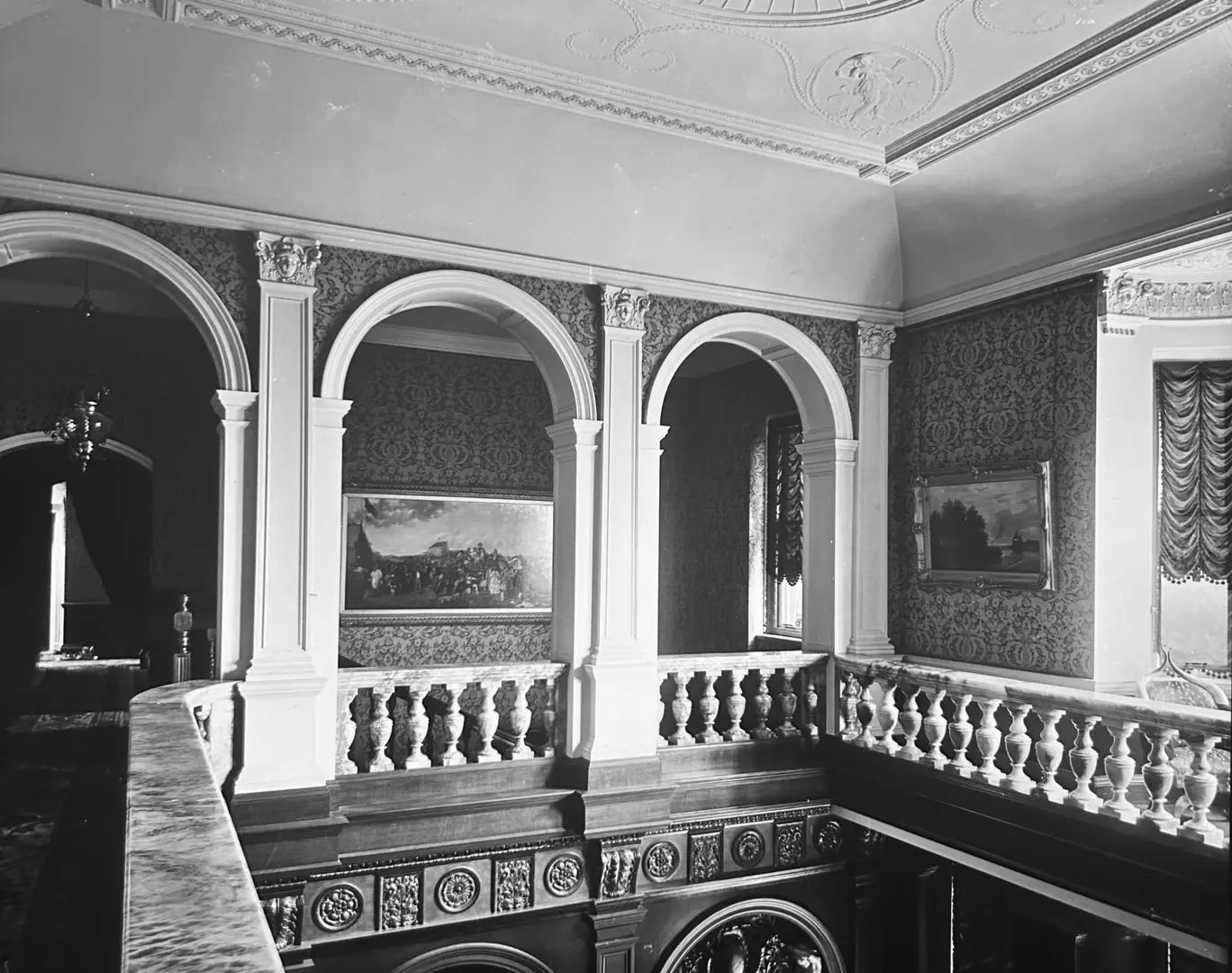
- From the Hall was the broad main Stairway to a Gallery, protected by a handsome marble balustrade encircling the first-floor level. A glass-panelled door gives access to a Terrace on the South.
- Dining Room: 35 ft. by 21 ft. with an oak floor; the fireplace had a marble hearth and an oak chimneypiece, beautifully carved and ornamented in Acanthus designs, flanked by miniature Corinthian pillars and enclosing a painting. A service door gave access to the domestic offices.
- Study: 6 ft 6 ins. by 14 ft. with a tiled fireplace and chimneypiece inset with mirrors.
- Billiard Room: 38 ft. by 24 ft. with an open fireplace surmounted by a stone Tudor arch and a massive, handsomely carved chimneypiece bearing a Coat of Arms.
- Off the extension of the Entrance Hall leading to the Billiard Room was a Cloak Room and Gentlemen’s Lavatory with tiled floor, two marble-topped basins (h. and c.) and two separate W.Cs.
Domestic offices were also on the Ground Floor, secluded from the residential part of the house and arranged on either side of a Back Hall. The offices included a Butler’s Pantry, cupboards, fireplace and Strong Room; Flower or Boot Room with sink and “Permutit” water softener; Kitchen with double-oven, auxiliary range, two sinks (h. and c.) and dresser; Scullery with two sinks and auxiliary range; Larder with slate shelving, second Larder with “Frigidaire” refrigerator; Servants’ Hall with fireplace and sink and Store Cupboards. There was also the Housekeeper’s Sitting Room and Housekeeper’s Bedroom.
First Floor
- The Principal or West wing comprised a bedroom, 27 ft. 6 ins. by 21 ft., with two tiled fireplaces, both with finely carved chimneypieces, one enclosing a mirror.
- A Boudoir, 20 ft. by 20 ft., with moulded panelling, a moulded ceiling, and a fireplace with a marble surround. A full-length plate-glass window opened to a Balcony on the South, protected by a stone balustrade.
- Bathroom with porcelain-enamelled bath on white-tiled base and having shower and spray fittings, fitted basin (h. and c.) and W.C. Dressing Room with tiled fireplace and moulded chimneypiece.
- A Suite comprising a bedroom with tiled fireplace, marble surround and marble chimneypiece inset with mirror. A plate-glass window on the South opened to a small Balcony with a stone balustrade.
- Adjoining was a Dressing Room with a tiled fireplace and a mirror inset in the chimneypiece. Bedroom, 13 ft. 6 ins. square with tiled fireplace. Bathroom with a porcelain-enamelled bath, shower, and spray fittings. Separate W.C.
- The South East wing comprised a Suite including a bedroom measuring 23 ft. 6 ins. by 18 ft., with a tiled fireplace and marble surround. A Dressing Room or Bedroom about 14 ft. 6 ins. by 13 ft. 6 ins. with a fireplace having an onyx surround and two built-in wardrobe cupboards.
- The East Wing comprised two Bachelor’s Rooms measuring, respectively, about 14 ft. by 16 ft. 6 ins. and 14 ft. by 12 ft., each with a suitable fireplace, and one having a built-in fitment of a chest of drawers and a wardrobe cupboard with a mirror-panelled door.
- Bathroom with porcelain-enamelled bath and fitted basin (h. and c.). Separate W.C. Linen Room with heating pipes. Second Linen Room and a Servant’s bedroom.
Second Floor
- A Suite comprised a bedroom, about 22 ft. by 14 ft., with a tiled fireplace and magnificent chimneypiece, and a Dressing Room about 14 ft. by 12 ft. with a fireplace.
- A bedroom, about 14 ft. by 13 ft. 6 ins., with a fireplace and two cupboards.
- An additional two servants’ bedrooms and an Airing Room or third Bedroom; also a Servants’ Bathroom with bath and W.C.
- A Range of Large Attics with boarded floors, used for storage purposes and as Tank Rooms.
As shown in the photo gallery later in this section, the rooms were large and airy. The decor and furnishings were a splendid example of the tastes prevalent in the mid-Victorian period. Today’s tastes are very different, and the interiors may appear ornate and cluttered by modern standards.
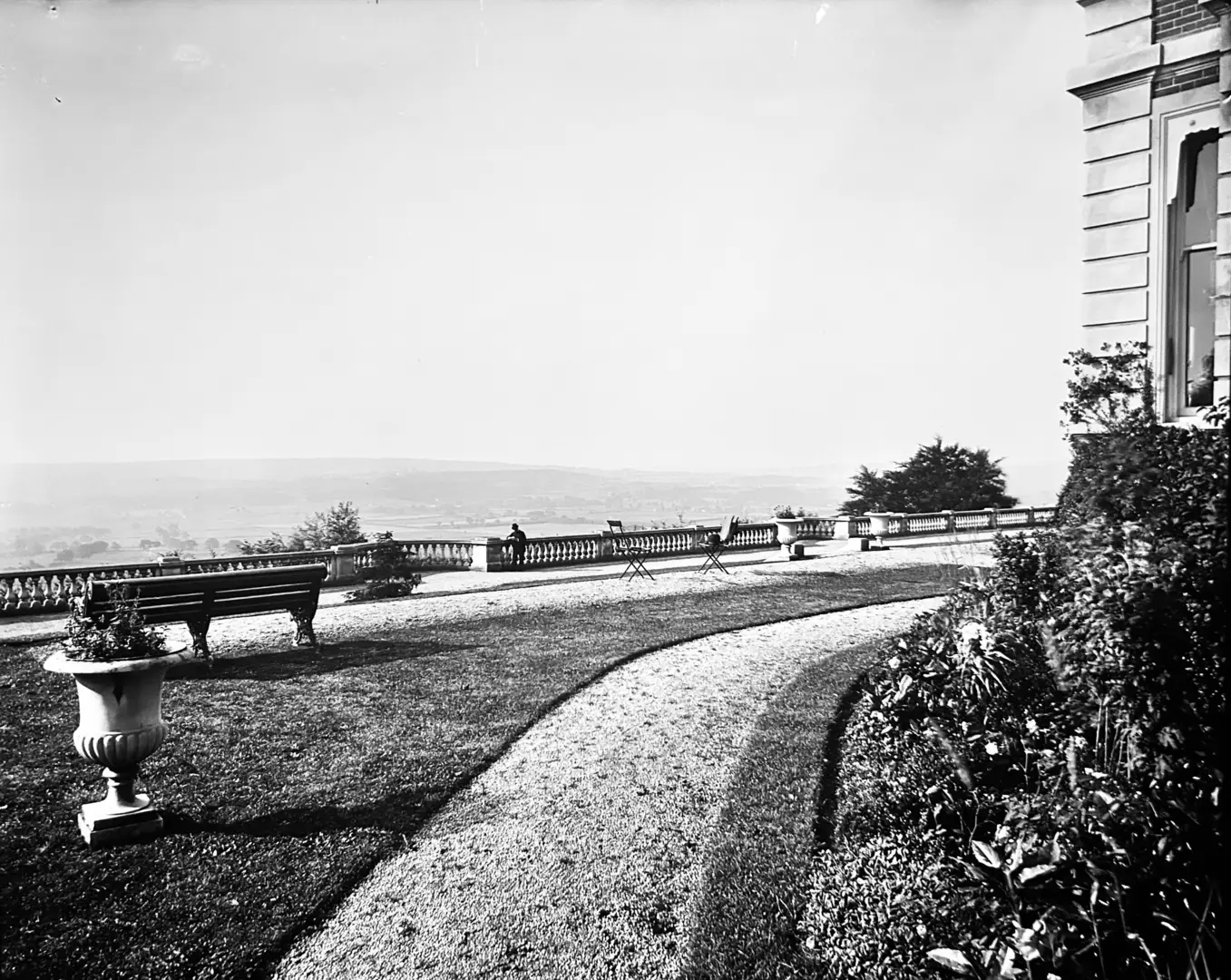
The gardens were screened by well-grown woodlands of beech, silver birch and hornbeam, which afforded complete seclusion. On the southern side of the Mansion was a paved terrace walk, protected by a stone balustrade, occupying the ridge crest; the grounds and pastures below fell to the ancient Pilgrims’ Way. The views were spectacular, and the fresh air was a welcome relief from London’s smog. In his later years, Sir Sydney found the open aspect and the pollution-free atmosphere very helpful for his health. He also spent time at his villa near Cannes in southern France for the same reason.
On the northern side of the house, a tennis lawn and a putting course lay beneath shrubberies of azaleas, maples, prunus, and lilac, and a rustic thatched summerhouse overlooked the lawn. The sloping lawn was flanked by beech and hornbeam woodlands, through which a path leads to a partly enclosed area with shrubs.
To the west, a sloping lawn was flanked by the kitchen and the fruit garden, which were partly walled, well-stocked, and had a whole southern aspect. The gardens were filled with mature fruit trees, with the wall partly covered in peaches. There were various heated greenhouses, including palm and carnation houses, tomato and melon houses, a vineyard, plant houses with ranges of pits, store sheds, tool and potting sheds. At one end of the kitchen garden was a rockery. This partly walled garden still exists, with the Gardeners’ mess facilities having been converted to a residential dwelling, The Pot House.

A ‘Lady Waterlow’ rose has been planted in the garden of the Pot House by the current owner. The garden is on the site of the old walled kitchen garden of Trosley Towers.
The ‘Lady Waterlow’ rose is a renowned climbing Hybrid Tea, introduced by French breeders Nabonnand in 1902 and named after Margaret Hamilton (1849–1931), a California heiress and the second wife of Sir Sydney.
Known for its large, semi-double, salmon-pink flowers with yellow centres, it is a recurrent bloomer that remains popular for its fragrance, disease resistance, and suitability for walls or pillars. The rose is often described as “big” and “blowsy,” with a delicate, “careless” appearance. Its petals are silvery salmon-pink, with a pale yellow centre and pinker edges, sometimes fading depending on conditions. ‘Lady Waterlow’ remains a cherished “old” rose often featured in historic gardens for its elegant, trailing blooms.
The woodlands contained a great many fine oaks and beeches, with hornbeam, sweet chestnut and ash underwood. They were intersected by paths affording charming sylvan walks. Adjoining one of these was a timber-built summerhouse or garden room with a tiled fireplace, kitchenette and a verandah facing full south, looking over the “Pilgrims’ Way”. At a later stage, on part of the land near Harvel Road, a cricket pitch and a golf course were created for the use of visitors to the house and the staff.
The Trosley Towers mansion was completed in 1887, which was seven years after the death of Sir Sydney’s wife, Anna Maria. He remarried in 1882 to Margaret Hamilton, and she called it home until his death in 1906.
Note: The following gallery contains photos of the exterior and interior of Trosley Towers. Please click on an image to view it in full size. The text article continues below the gallery.


Sir Philip Waterlow
Following Sir Sydney’s death in 1906, the estate passed to Philip Hickson Waterlow, who was the second son of Sydney and Anna Maria Waterlow, and was born on 30 October 1847 in Hoxton, London. He married Amy Grace Lutwyche in 1869, and they had six children together. Amy died in 1897, aged 48, and Philip remarried the following year. His second wife was Laura Marie Jones, and they married in Quebec, Canada, when she was 39 and he was 50.
Philip became Chairman of the family stationery and printing company in 1876 and served thus for over 47 years. He became a Director of the Employers Liability Assurance Corporation upon its start-up in 1880 and also served there for over 50 years, until his death. He was elected a Lieutenant for the City of London and served as a Justice of the Peace for the County of Kent. Philip was appointed as High Sheriff of the County of Surrey in 1905.
Philip’s elder brother, Frank, died in 1871 in Genoa, Italy, aged 25, and so Philip inherited the Trosley Towers Estate on his father’s death in 1906. The 1921 census records Philip at Trosley Towers, shown as Chairman of Waterlow’s, with 8 servants.
In his later years, he was a keen painter, amongst several other hobbies, and rural Kent must have suited him well for this. He arranged and paid for the erection of the ‘Chapel of the Holy Innocents’ in Fairseat, for the children of Stansted convalescent home at Fairseat Manor, in memory of his wife, father and mother.
Sir Philip died at Trosley Towers on 20th September 1931; the funeral was held in the new Fairseat Chapel, and he was buried in the family plot at St Mary the Virgin, Stansted.
Note: Further information on Sir Philip Waterlow is available under ‘Luminaries’, within the ‘People’ section.
Visitors Book

Chris Smeeton has kindly donated the original leather-bound ‘Visitors Book’ that catalogues visitors to Trosley Towers between 1908 and 1931. It would appear that Sir Philip Waterlow introduced and managed these visitor records, as the entry dates align with the period during which he owned the estate and occupied the mansion house. The original Visitors’ Book is now stored in the Society’s physical archive at Fairseat Village Hall.
Chris acquired the Visitors Book from his great-uncle Ronnie (Ronald James Waterlow 1916-1991). Ronald Waterlow was the son of Edgar Lutwych Waterlow (1870-1954), who inherited Trosley Towers and the estate from his father, Sir Philip Waterlow, upon his death in 1931. It was Edgar Waterlow who organised the sale of the estate between 1932 and 1935.
The contents of the visitors’ book may be viewed by selecting the following link: Trosley Towers Visitors Book
Recollections
Alfred Roots (1892 – 1975) worked at the estate from 1908 as a garden boy and recalls the following:
“The Head-gardener was a Mr Cook. At the time, the vegetable plot belonging to the Towers was on the right-hand side of the drive, which went in by the North Lodge. The drive went down and over the bridge spanning Trosley Hill, then bore up to the Towers, which stood majestically overlooking the valley that ran through to Brimstone, including Happy Valley. The drive extended from the Towers crossing Hogmore Lane, by the Head-gardener’s cottage, to a point on the Wrotham Road coming out at the end of the straight length of road past the Vigo Inn, where two brick pillars stood, one each side of the drive.
While I worked there, a new drive was made through the wood from a point between the Towers and the main road to the South Lodge, nearly opposite the McMillan Home. This was occupied by the Head Chauffeur. Here, I might mention his name was Pillar. Other men who worked there were Stone, Frost, and Fogg. Stone was the Butler, Frost was the old chap who swept the drive, and Fogg worked in the vegetable garden.
The estate also had its own dairy and three cottages situated a short way up the Fairseat Road. These were occupied by the Dairyman, Under Gardener and Estate Carpenter.
Down the road, which goes in by the bus shelter by Vigo Inn, the buildings there were composed of the Electrician’s shed, Coachman’s cottage, gardens, carriages and stables. The staff there consisted of a Coachman, a Groom, two Chauffeurs, and an Electrician. Their livery was blue and gold. The indoor staff consisted of 4 house maids, a scullery maid, a kitchen maid and cook, a ladies’ secretary and ladies’ maid, a butler, and two footmen. The farm steward occupied the Hopkell House at Millars Farm. The meadow between the A227 and the Harvel Road was a Golf Course and a Cricket Pitch used by the staff who played matches against Holywell Park, Trottiscliffe and other teams.”
Note: Alfred Roots full recollections are available under ‘Recollections’, within the ‘People’ section.

Following Sir Philip’s death in 1931, the estate passed to Sir Edgar L. Waterlow, and some of the estate properties were sold to existing tenants/occupiers. Sir Edgar offered the remaining estate for sale at an auction held in the Estate Room, No. 20, Hanover Square, London, W.1, on Thursday, 21 July 1932. The auctioneers were Messrs. Dann & Lucas, Dartford, Kent, and Messrs. Knight, Frank & Rutley, 20, Hanover Square, London, W1.
The auction map shows the two main areas of the estate offered for sale. Lot 1 to the southeast of Vigo Hill and Lot 2 to the northwest. The areas occupied by Miller’s Farm and Pilgrim House were not included as they had previously been sold privately. Despite a second auction in 1934, the estate remained unsold until 1935, when it was privately acquired by Mr Ezekiel Shahmoon, a wealthy merchant and bullion dealer of Iraqi descent.
It is understood that Shahmoon had intended to live in Trosley Towers but had been away for a long time with an illness. He and his brothers had moved away from Trosley Towers in March 1935, and on his return in February 1936, he found the property stripped of all its lead and in such a poor state that the best course of action was to demolish it. Sadly, the mansion house was subsequently reduced to the ground, and only a few foundations remain.
It is believed that he planned to build a new house on the site with a golf course, but this never materialised. He did, however, create a large stable block at the back of Hamilton Lodge, and it is suggested that the stables were constructed to accommodate the Shah of Persia’s racehorses on his visits to England. The stables at Hamilton Lodge stood until about 1960, when they were demolished, and the rest of the site cleared to make way for the development of Vigo Village. Mr Shahmoon himself lived at North Lodge, and members of his family who had fled from pre-war Europe occupied other properties on the estate. Most of his family then moved on to New York state, but Ezekiel Shahmoon remained at North Lodge until his death in 1972, aged 81.
There is very little evidence of the mansion left today, and satellite images do not reveal any remnants, just woodland. Any plans Mr Shahmoon had for the estate were cut short by the outbreak of World War II.
Note: Further information on Ezekiel Shahmoon is available under ‘Luminaries’, within the ‘People’ section.
The War Years
The Trosley Towers estate was still owned by Mr Shahmoon when it was requisitioned by the army in 1942, and Hamilton Lodge would become the headquarters of the Brigade stationed there.
With the outbreak of war and the subsequent increase in size of the army, the need for large numbers of suitable candidates to train as officers became apparent. This training was normally undertaken at an Officer Cadet Training Unit attached to the arm of the service in which the cadet would eventually serve. Because each OCTU. was required to ensure fitness and teach basic army skills, duplication of resources occurred; standards varied from unit to unit; and, most importantly, the levels of skill and basic army training of individual cadets varied considerably.
In the early part of 1942, it was therefore decided to standardise this basic training and send all potential officer cadets to a pre-OCTU for up to eight weeks before attending their ‘specialist’ OCTU. With a few exceptions, all officer cadets would now be required to attend this newly formed pre-OCTU, ‘Wrotham Camp’. On 20 July 1942, the 148 Independent Brigade Group moved its HQ from Sarre, near Canterbury, to Wrotham and the largest pre-OCTU ever known was officially brought into being.
Training areas would extend northwards towards Meopham, and south to farmland beyond the Pilgrims Way. It would handle the vast majority of officers for the British Army for the next four years, up to 10,000 men at any one time.
The camp continued to operate through to the early part of 1946, and with the army’s departure in 1946, ‘squatters’ moved in. These were people who, for the most part, had lost everything they had during the Blitz. Here they found ready-made accommodation in the form of Nissen Huts, well-made roads, and soon a lively, friendly community was to form, albeit without a number of facilities regarded as essential to normal life (schools, doctors, etc.). The presence of some 1,000 people in the area prompted the Councils of Strood, Gravesend, West Malling and Northfleet to improve conditions for the inhabitants. The council made improvements to the buildings and infrastructure, providing reasonable sanitation, basic insulation and waterproofing. The interiors were divided with partition walls to provide at least three rooms, one of which would have a brick-built fireplace.
The old camp lecture hall, Erskine Hall, on what is now the School field, was still standing and served the community in various ways, and at one point, it was used as a storage facility for props from the London Palladium. A bus service was introduced alongside a shopping centre, ‘Piccadilly Circus’, which included a butcher’s, a Co-Op, a Café, a bakery, and a drapery store. There was a library, a barbers with a fully equipped salon, and Dr Jenman and Dr Haslar held a surgery in ‘Harley Street’ nearby.
The stables at the back of Hamilton Lodge, built by Mr Shahmoon, were used as a Primary School from about 1948. Prior to this, the children attended Meopham and Culverstone Schools. By the late 1950s, many residents had been rehoused in nearby areas, and the area was, to a certain extent, cleared.
Wrotham Camp was officially renamed Vigo Village by the council (now Gravesham Council) in 1947, and a school for the village’s children was proposed.
Note: Further information on the OCTU camp is available under ‘Landmarks & Places of Interest’, within the ‘Places’ section.
Vigo Village & Trosley Country Park
In 1962, Kent County Council purchased the area of the Trosley Towers Estate to the east of Vigo Hill, subsequently allocating 165 acres for the development of what was to become Trosley Country Park. After a lengthy planning battle, outline planning permission to develop some 800 residential properties was granted, and the remaining land was sold to an investment company associated with the housebuilder Croudace Ltd. This marked the beginning of Vigo Village as it exists today, with the first residents assuming ownership in 1965.
Note: The history of Vigo Village is available under ‘Local History’, within the ‘History’ section.
In 1974, plans to extend Vigo village with more housing were vetoed by Kent County Council due to the adverse impact on the North Downs landscape. At the same time, Kent County Council was preparing to create Trosley Country Park. The park was opened in May 1976, and the site on the edge of the North Downs was one of the council’s first two country parks.
Trosley Country Park is now home to a rich variety of wildlife and a mix of woodland and open chalk grassland. The chalk grassland in the area is classified as a Site of Special Scientific Interest, while the grassland supports an array of butterflies every summer, including the Chalkhill Blue.
There are 3 waymarked trails – the Downland Trail is very steep in parts, while the Woodland Walk is much gentler. The Trosley Trail is suitable for buggies and wheelchairs. All provide spectacular views over the downs. For the more adventurous, the park is also a good base to visit the Coldrum Stones, an ancient listed monument of 15 sarsen stones
Note: Further information on Trosley Country Park is available under ‘Landmarks & Places of Interest’ in the ‘Places’ section.
Conclusion
The history of 400 acres of unspoiled woodland in North West Kent, 150 years ago. A rich philanthropist’s country pile, an Iranian businessman’s dream, a huge Army training camp, a refuge for WW2’s dispossessed, a new village in the countryside and a Country Park with magnificent views.