
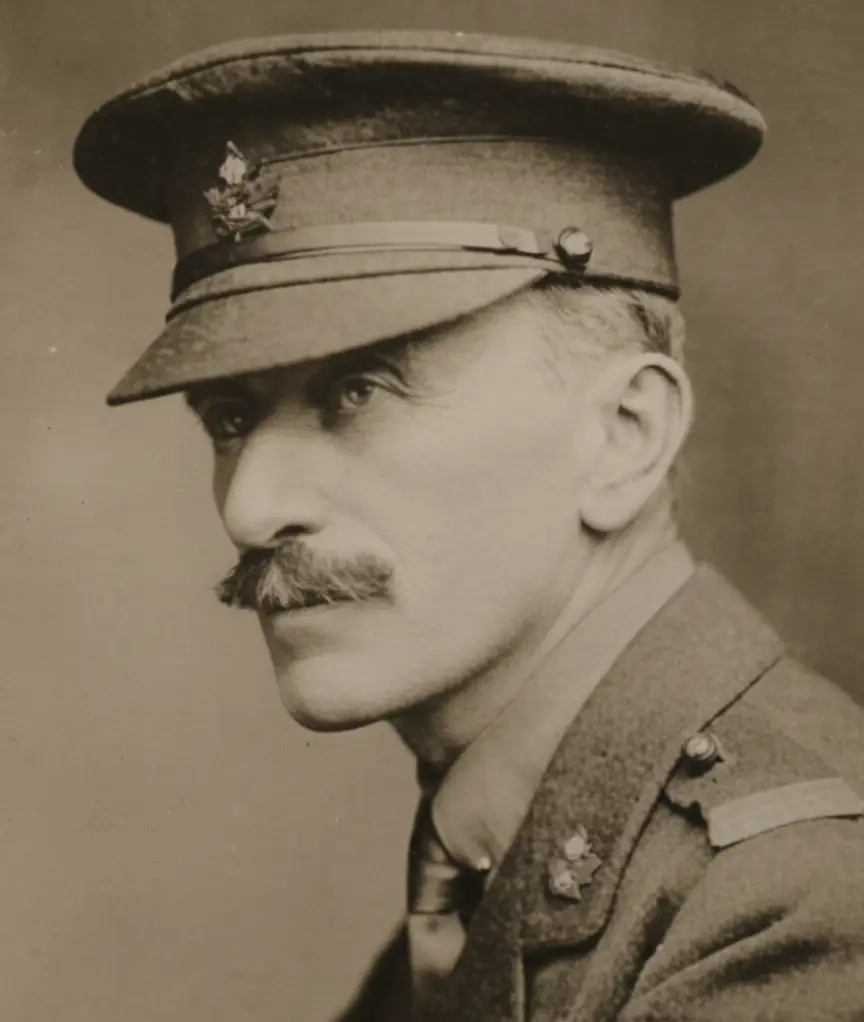
KEMBALL ARNOLD HENRY GRANT, Lieutenant-Colonel. C.B., D.S.O. 54th (Kootenay) Battalion, Canadian Infantry (Central Ontario Regiment).
Born 4th January, 1861 and died Thursday, 1 March 1917. Aged 56.
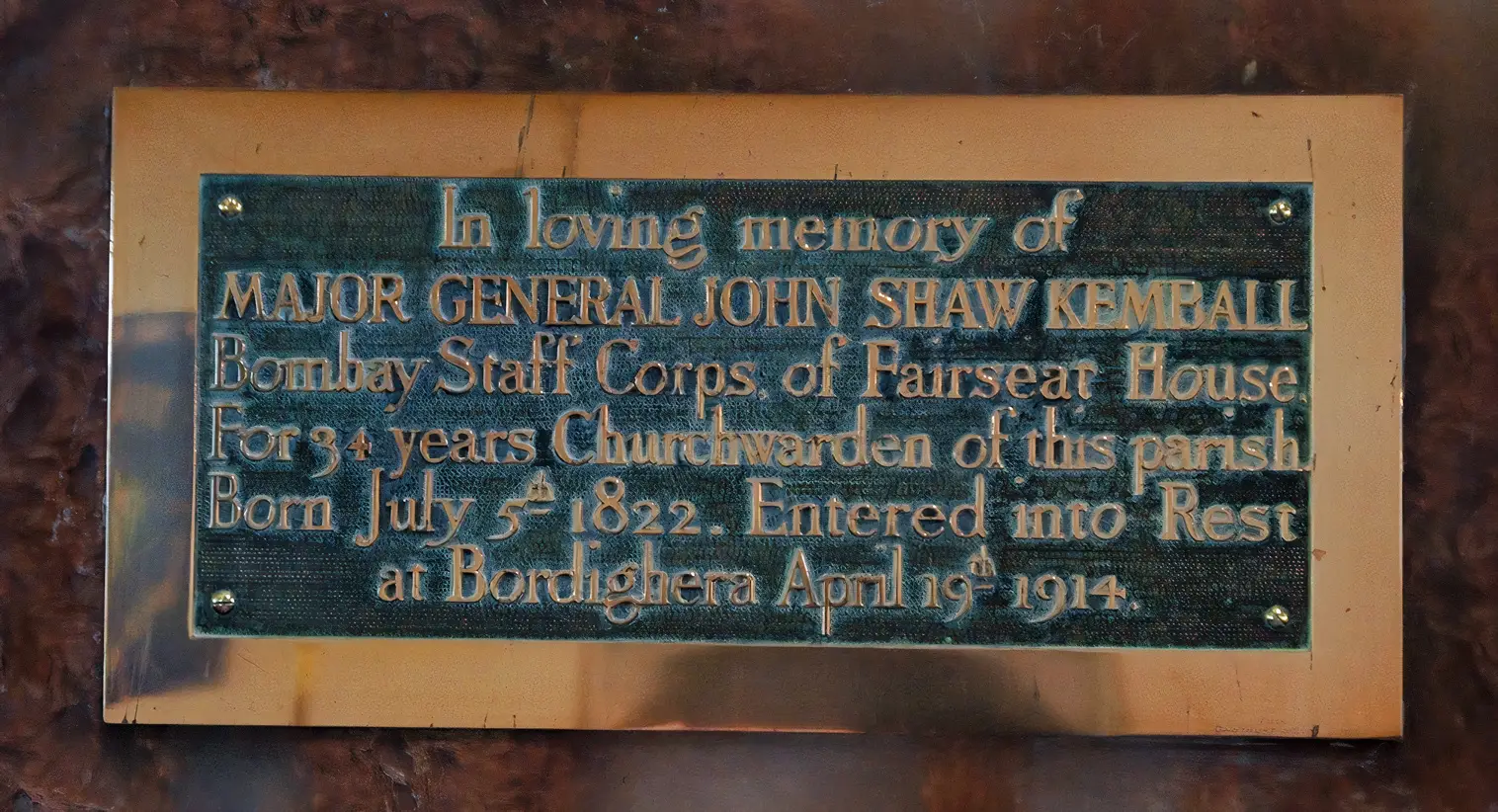
Second son of the late Major-General John Shaw Kemball of Fairseat, Sevenoaks, Kent, and of the late Dora Margaret Kemball (née Adams). Brother of Major-General Sir George Vero Kemball, K.C.M.G., C.B., D.S.O., R.A.
Buried Villers Station Cemetery, Villers-au-Bois, Pas de Calais, France. Grave Ref: VI. E. 1.
Arnold Kemball is commemorated on the Stansted War Memorial, the Roll of Honour in St Mary’s Parish Church, the Canadian First World War Book of Remembrance, and on the Wellington College (Crowthorne, Berkshire), Great War Roll of Honour.
Note: Further information on the War Memorial and St Mary’s Church is available under ‘Landmark’ in the ‘Places’ section of this website, or can be accessed via the following links:
Stansted War Memorial
St Mary’s Church
Arnold Kemball was born on Friday, 4 January 1861, in Belgaum, Karnataka, India, 250 miles south of Bombay (modern Mumbai). His family had a long tradition of military service in India. His grandfather, Vero Shaw Kemball, had been the Surgeon-General for Bombay and his father, John Shaw Kemball, had lived in India since 1839 and was a Major General in the 29th Punjabis North-West Frontier Force when he retired in 1877. Arnold’s mother, Dora Adams, was also born in India. They had four sons and four daughters. Arnold’s older brother George also became a Major-General, served with distinction in India, Africa, and Mesopotamia (WW1), and was awarded the DSO (Distinguished Service Order), KCMG (Knight Commander of the Order of St. Michael and St. George), and CB (Companion of the Order of the Bath).
The family moved to Fairseat House, Fairseat, Kent, in 1863 and lived there for 51 years until Arnold’s father, John Kemball, died in 1914 at the age of 92. He was a churchwarden of St Mary’s Church, Stansted, for 34 years, and in 1917, after his death, his family gifted £50 to the church to fund a memorial to him and to benefit the church. This sum was used to pay the insurance premium for the church, chancel, and contents. Note: £50 was equivalent to £4,500 in 2025.
At the time of the 1871 census, he was recorded as being a 10-year-old pupil at a school in Frant Green, Sussex. Head of the house was 53-year-old widow Elle E. Adams, a native of London, who was a Schoolmistress. Arnold subsequently attended Wellington College, Crowthorne, Berkshire, where he was a member of Hopetoun House, and, like many of his peers, he then enrolled at the Royal Military Academy, Sandhurst.
Following the completion of his formal education at the Royal Military Academy, Sandhurst, in 1880, Arnold was commissioned as a Second Lieutenant in the 1st Battalion, Royal Scots, before going to the Indian Army and joining the 5th Gurkha Rifles. During his early service in India, Arnold saw action in the Black Mountain Expedition in 1888, the Hazara Expedition in 1891, the North West Frontier Expedition in 1897-98, and the Tirah Expeditionary Force in 1897-98. He was mentioned in Dispatches for his service on both the North West Frontier and Tirah.
In 1893, while on leave in England, Kemball went on a winter holiday to Norway and became snowed in at a ski lodge. Also trapped with him was an eighteen-year-old Norwegian girl, Alvilda “Vivi” Sundt and her mother. By the end of their ten-day confinement, they had fallen in love. Two years later, Kemball returned to England once more, and they were married. According to the announcement in The London Standard, the ceremony was celebrated at St. Mary’s Church, Stansted, Kent, the home parish of the Kemball family. The bride was described as the second daughter of the late Fredrik Christian Dreier Sundt of Christiania (now Oslo, Norway). After a brief honeymoon, the Kemballs travelled to India, where Arnold introduced his young wife to life on the frontier.
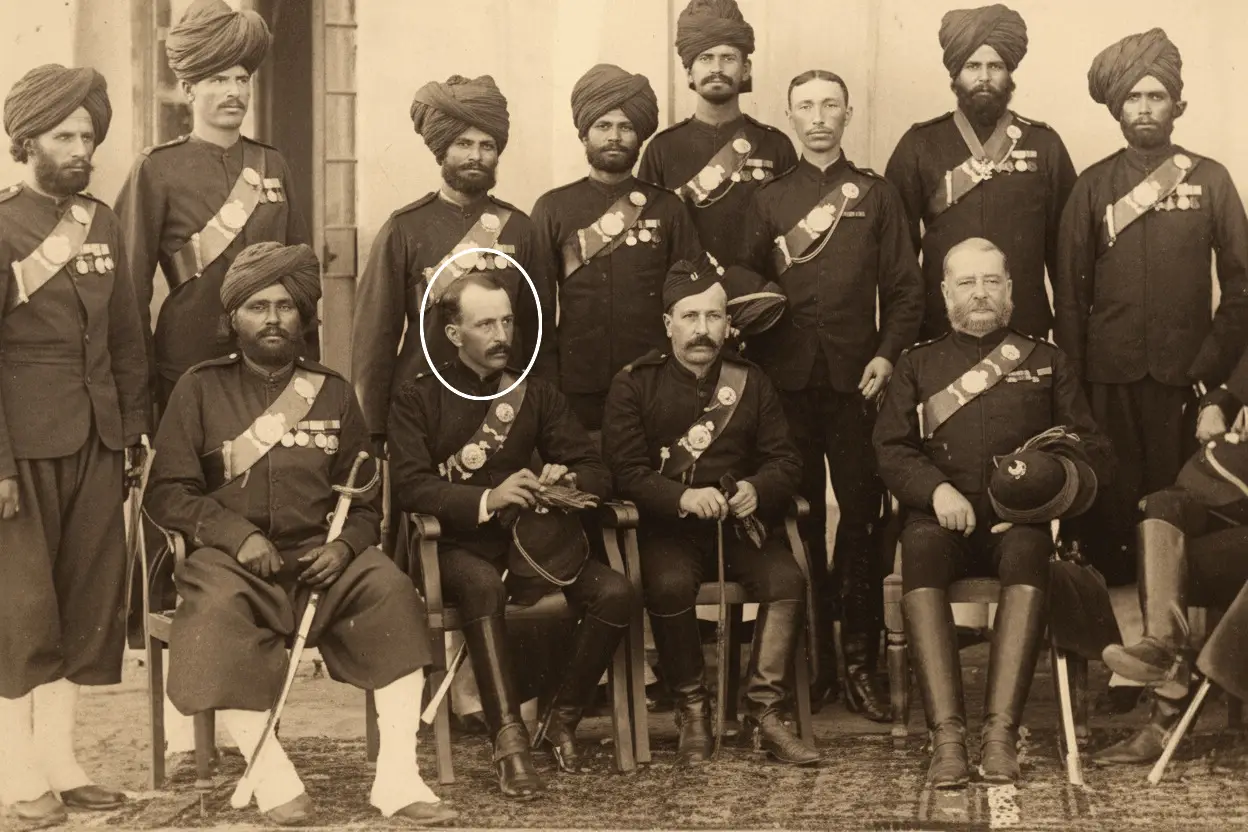
They took up residence in Abbottabad, which was the British military headquarters for the Peshawar region and home to the Gurkha regiments. There, Alvilda gave birth to two daughters, Dorothy Mary (1896) and Gerda Cecelia (1899).
In 1897, the North West Frontier was again set ablaze when the Afridi tribesmen, who had been paid by the British to guard the nearby Khyber Pass, suddenly rebelled and occupied all the forts along the India-Afghanistan border. The subsequent Tirah Expedition was one of the most difficult colonial campaigns the British Indian Army faced. Arnold, then Captain Kemball, was mentioned in despatches for his role in the fighting and was soon promoted to the rank of Major.
In 1905, Kemball was promoted to Lieutenant Colonel and given command of a battalion of the 5th Gurkha Rifles. Two years later, in 1907, he was appointed Colonel of the entire regiment, and in 1912, two years after his retirement, he was made a Companion of the Order of the Bath (CB) in recognition of his service in India.
The Kemballs returned to Kent in 1910 and installed their daughters, now eleven and eight years old, at Belstead House School in Suffolk. The school had been established for the children of military families serving in India, and the girls remained there for the next three years.
After an active and sometimes perilous career on the North West Frontier, the prospect of a tedious retirement in England did not appeal to the Kemballs, who were still relatively young (Arnold a fit forty-nine, and Vivi only thirty-five). Even less appealing was the descent from oriental luxury, surrounded by an army of servants, to a modest residence in Kent where a respectable social position would have to be maintained on a Colonel’s modest pension.
Inspired by the novels of Rudyard Kipling, Rider Hagaard, and John Buchan, as well as dreams of adventure and prosperity, thousands of English men and women were flocking to South Africa, Kenya, Australia, Canada and other outposts of Empire, the poor to work in mines and farms, their wealthier cousins, “remittance men” and retired military officers like Kemball, to establish ranches and plantations. In 1910, one of the more exotic locales was the Kootenay District of British Columbia, whose cherries, apples and berries were winning prizes across Canada and even at fairs in London.
The Kemball family decided to set sail for a new life in British Columbia. The following is Gerda’s account of their first year at Shutty Bench in Kaslo.
“We made tremendous strides in 1911. By December, with the help of Haugen and Adriana, the Norwegian couple who had followed us out, we were looking after pigs and chickens, some land had been cleared, and thanks to the efforts of a dear old Scot, Lachy MacLean and the two Guthrie boys, the exterior of a spacious house had been completed. The beaver board required to line the interior walls, however, had gone astray, as had also our furniture, which by now had been months in transit.
As the winter days shortened, my mother decided that we should have some proper Scandinavian festivities at Christmas time to dispel our feelings of isolation. Father was accordingly ‘dispatched’ to Kaslo in our small, one-cylinder open-air launch, christened GURKHA, with invitations to Mr & Mrs James Anderson, Mr & Mrs Treby Heal and Major and Mrs Stubbs of Kaslo and to Bill and Maitland Harrison from Queens Bay, to come up to our ranch the day before Christmas and stay overnight. Dorothy and I were given a brief holiday lesson from our daily school lessons, which father had been diligently conducting, and all efforts were bent towards preparing our rustic surroundings for the festive season.”
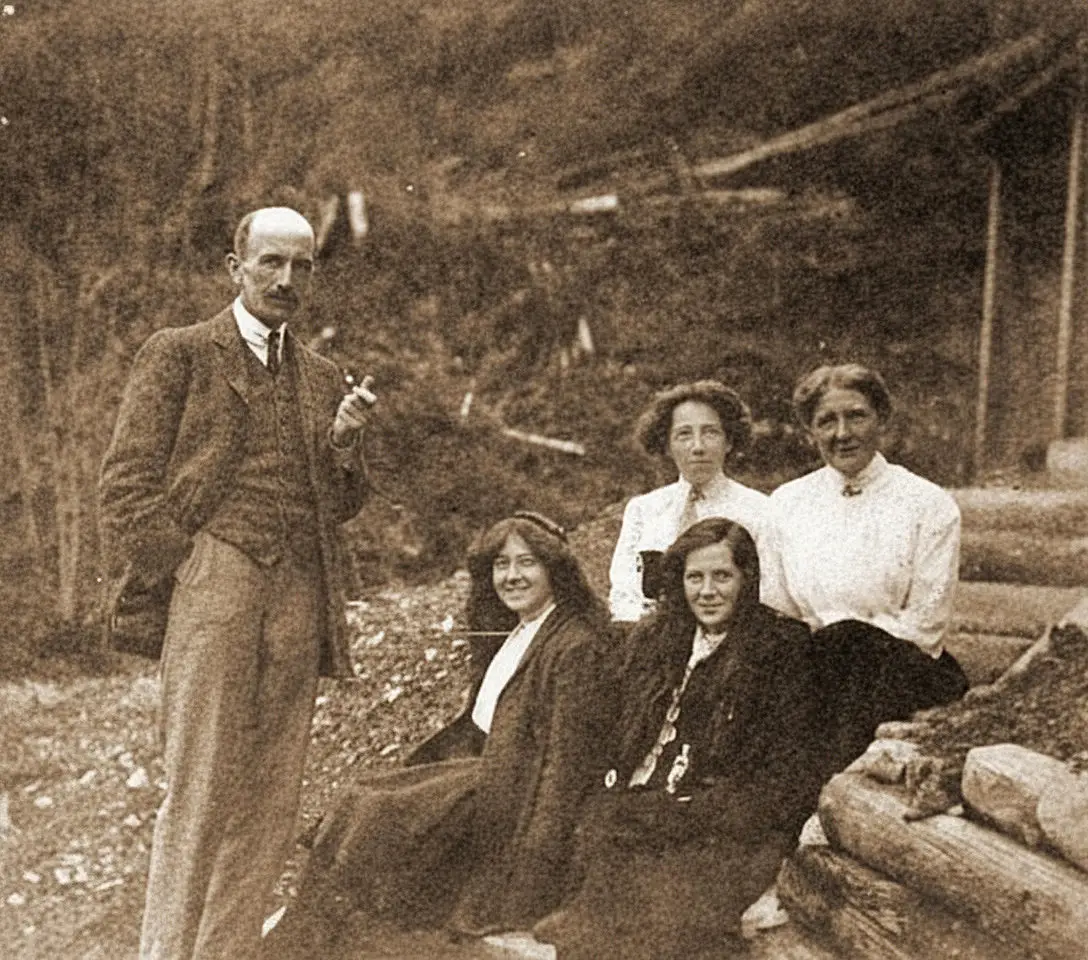
Three days before Christmas, the Kokanee made an unscheduled call at our beach, and to our absolute amazement, mother’s older married sister, Mrs Jakhelen, walked down the footplank. As one of a lifelong series of futile measures to cure her husband of alcoholism, Agnes had set out from Norway with him to try homesteading on the Canadian prairie. Several months wrestling with nature in the wilds of Alberta, having effected no improvement in Uncle’s drinking habits, Agnes had decided that she owed herself a long vacation, so she had packed her bags and caught the train west to the Kootenay District.”
Over the next few years, the Kemballs planted cherry trees and berry bushes and raised chickens and pigs. They also had a large area given over to strawberries. Although they worked hard, there was also time in the Winter for skiing and tobogganing, and in the Summer for swimming, boating, and fly-fishing. It was an idyllic existence, and there were many happy-go-lucky Englishmen revelling in life on the frontier.
A year after emigrating to Canada, Arnold was made a Companion of the Bath for his services in India. Canada entered the First World War on 4th August 1914 , automatically, because Britain had declared war on Germany, and Canada was part of the British Empire. Despite being 54 years old at the time, Arnold enlisted in the Canadian Overseas Expeditionary Force at Vernon Camp, British Columbia, in June 1915. Prior to his enlistment in the Canadian Overseas Expeditionary Force, Arnold had already served for a total of 32 years in the British and Indian Armies.
Following his re-enlistment, Arnold was initially placed on the roll of the 107th Canadian Infantry Regiment at Fernie, British Columbia, but for obvious reasons, was quickly appointed as a Major and Deputy Commanding Officer of the newly formed 54th (Kootenay) Battalion, Canadian Expeditionary Force. During the initial training stage of the battalion’s existence at Camp Vernon in July 1915, Arnold was promoted to the rank of Lieutenant Colonel and became the Commanding Officer of the battalion.
The 54th (Kootenay) Battalion sailed for Britain in two batches; the first, 250 men and 5 officers in July 1915 and the second, of similar size in November 1915 aboard the troop ship Saxonia.
Having led the battalion throughout its training in Canada and later in England, Arnold continued to
command the battalion on the Western Front from August 1916, where his battalion joined the recently formed 11th Canadian Infantry Brigade of the 4th Canadian Division. After more training in the
relatively quiet sector of the Ypres Salient, Belgium, the battalion went to the Somme, France.
In an action fought on Saturday, 18 November 1916, Arnold led his battalion in a highly successful attack on an enemy trench complex named ‘Desire Trench,’ and it was for this action that he was subsequently awarded the Distinguished Service Order. The London Gazette entry for the Distinguished Service Order is dated Wednesday, 10 January 1917, and also on page 2791 of the Canada Gazette, dated Saturday, 10 February 1917. The citation reads: “For conspicuous gallantry in action. He led his battalion in the attack with conspicuous success and carried out every task allotted to him. He set a splendid example of courage and good leadership throughout.” Both Gazettes also list his Mention in Dispatches, post Arnold’s demise.
Following the success at Desire Trench, the 54th (Kootenay) Battalion travelled north to the Vimy Front to join the rest of the Canadian Corps. In late February 1917, the 54th (Kootenay) Battalion was ordered to carry out a large trench raid in conjunction with other battalions of the 4th Canadian Division. Instead of a preliminary artillery bombardment of the enemy positions to be attacked, this raid used gas. Arnold fell whilst leading the 54th (Kootenay) Battalion from the front, when it was carrying out the raid during the disastrous gas attack, and he was initially posted as missing.
On Saturday, 3 March 1917, a temporary truce was called to recover about 200 officers and other ranks who fell during the raid. Of the 405 soldiers participating in the raid, in excess of 200 were casualties. It is recorded that “recognising the Canadian officer Lieutenant-Colonel Kemball’s gallantry and devotion to duty, the Germans returned his body with great respect.”
Following the confirmation of his death, Arnold’s wife was informed, as was his sister Miss E. Kemball of ‘Brackenhill,’ Borough Green, Sevenoaks, Kent. Having previously let his superiors know in no uncertain terms that he was “utterly convinced that the raid had very little chance of success,” On the day of the raid, Arnold defied orders and personally led two of the companies engaged in the raid. The companies had lost direction due to the poor visibility, and Arnold moved to lead the left-hand company on the proper bearing. It was whilst trying to find a gap in the enemy wire that he was killed in action.
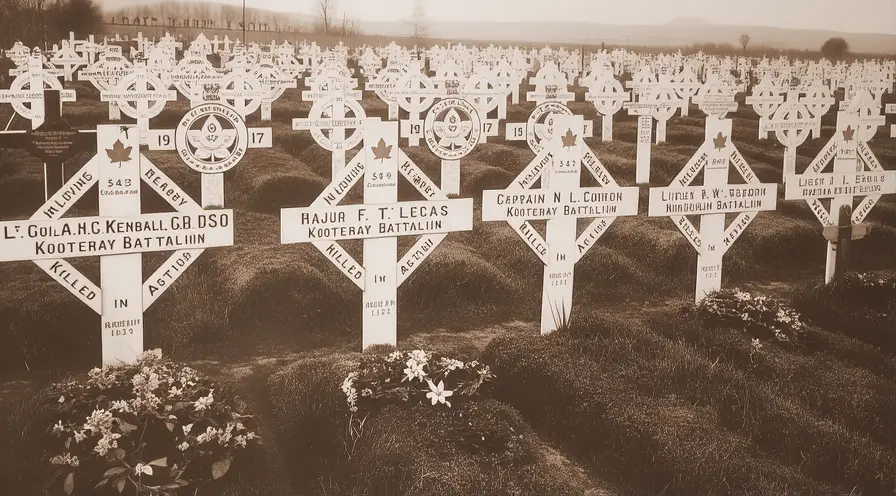
Villers Station Cemetery, where Arnold is at rest, is located approximately a mile north-west of the village of Villers-au-Bois and was begun by the French but used by Commonwealth divisions and Field Ambulances from the time they took over this part of the front in July 1916 until September 1918. It is associated particularly with the Canadian Corps, whose headquarters were nearby, and many of the graves in Plots V to X date from April 1917 and the Battle of Vimy Ridge. After the Armistice, a few graves were brought in from isolated positions in the neighbourhood, and in June 1923, the French graves were removed, with the great majority sent to the Notre-Dame-de-Lorette French National Cemetery. Villers Station Cemetery now contains 1,208 Commonwealth burials of the Great War and 32 German war graves.
The story is taken up by Stan Bostock, the 54th Battalion president, who gave the following oration when the 54th met in Kalso on 3rd September 1939 to celebrate the 23rd anniversary of the taking of Desire Trench
“Again, we are here to pay tribute to a very gallant gentleman, Colonel Kemball, our comrade, our Colonel, from your city. One can find no braver, no finer gentleman in the whole Dominion of Canada. Strict in discipline, fair in giving praise or reproach, he was always willing to listen to the men under him and always to the front in their interest and welfare – never asking a man to do what he would not do himself – that is comradeship. Let me tell you of the day when our Colonel gave his life for his country. We have with us a few men who remember that day at Vimy, the 1st March 1917, probably better than they do any day last week. Col. Kemball had realised that the gas released had not done the work expected of it, and phoned headquarters that the attack would be a failure, but his orders were to go ahead. So he just grabbed a rifle and led the Battalion to such disastrous results. The Germans, one of the few times in the history of the Western Front, called an armistice for three hours, to give us a chance to pick up our dead and wounded. Col. Kemball, Major Lucas, and a host of others, too numerous to mention, were among them. Our Colonel, with 16 bullet holes in him, was hanging on the German wire, rifle in hand, game to the last. The Germans carried his body partway across No Man’s Land, commenting, A very brave man.”
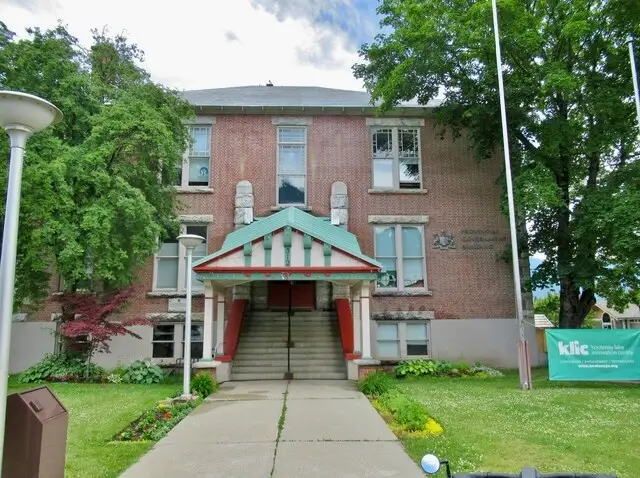
Arnold Kemble was held in very high regard in Canada, and several local features in British Columbia were named after him, including Mount Kemball (in Kokanee Glacier Park), Kemball Creek, etc. In addition, there is a memorial centre in Kaslo that bears his name. The commemorative plaque on that building reads “In loving memory of Col. Arnold Henry Grant Kemball, C.B., D.S.O. Late of the 5th Gurkhas, Indian Army. Killed in action. Vimy Ridge, France. In command of the 54th Batt. C.E.F. March 1st 1917. This tablet is erected by the men of his battalion.”
Extract from the Stansted Parish Notes, October 1976, by local resident Hugh Pasteur:
“On September 1st 1976, a visit was paid to the Parish by a certain Mr David Grier [Note 1] and his wife, who live in Chicago, U.S.A. They called first of all at the Vigo Inn and spoke with Mrs Ashwell, who recommended they see the Rector, where I happened to call in and was introduced to them. Mr Grier’s mother, who lives in Mexico, was born Dorothy Kemball. Her father was Colonel Arnold Kemball, son of General John Kemball, who lived in Fairseat House. Both Colonel Kemball and his father, General Kemball, are commemorated on tablets in Stansted Church. Colonel Kemball’s name is also on the War Memorial. Mr Grier was naturally very interested in Fairseat House, his great-grandfather’s home, and I showed then round. When we were on the lawn in front of the house, he remarked that his mother remembered playing tennis on the lawn and that amongst the guests playing tennis, she played with Mr Anthony Eden [Note 2] in white flannels and a straw boater, who used to visit his uncle, the then Rector of Wrothan, before World War I. Mr Grier’s mother [Note 3] had remembered the area so well that she could give precise instructions for finding Fairseat. After a visit to Stansted Church, we repaired to the Black Horse, where the Griers and the Rector and my wife and I partook of an excellent ploughman’s lunch.”
Note 1: David Grier’s father was Robert Grier, and his mother was Dorothy M Kemball, Arnold Kemball’s daughter and John Shaw Kemball’s granddaughter.
Note 2: Robert Anthony Eden, 1st Earl of Avon (12 June 1897 – 14 January 1977), was a British politician and military officer who served as Prime Minister of the United Kingdom and Leader of the Conservative Party from 1955 until his resignation in 1957.
Note 3: Dorothy was born in 1896 in India and spent much of her early years there. Her parents moved to Canada in 1910, and she followed them. Her grandparents lived at Fairseat House until 1914, so she must have played tennis on a visit to her grandparents.