
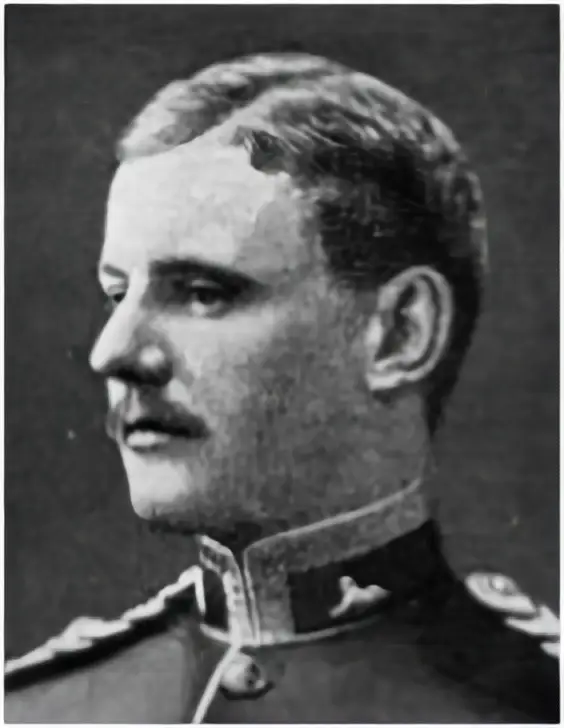
James Pitt was born in 1888 in Kensington, London, and, as a Lieutenant in the Dorsetshire Regiment, was killed in action in Northern France on 13th October 1914. He was 26 and unmarried. His brother William was also killed later in the war.
James was the younger of the two sons of Colonel William Pitt, C.M.G. and Mary Pitt née Brindley. He was born on Thursday 23 August 1888. His father became a Colonel in the Royal Engineers, and James was baptised at Mean Meer, Bengal, India on Sunday 13 January 1889. His brother William Neville had been born in 1880, in Bombay, India and his sister, Mary Winifred (May), had been born in England in 1882.
James is recorded as a 12-year-old schoolboy at Hartford House School, 30 High Street, Hartley Wintney, Hampshire, when the 1901 census was taken. The head of the house was the 56-year-old Headmaster, Edward Wynell Mayra Lloyd, M.A., who was also born in India.
Ten years later, at the time of the 1911 census, James is recorded as being a 22-year-old Lieutenant in the 1st Battalion, Dorsetshire Regiment stationed at Longmoor Camp, Longmoor, East Liss, Hampshire. The Battalion sailed for France from Belfast, Ireland aboard the SS St. Anthony on 14 August 1914, just 17 days after war had been declared between the UK and Germany. Made up of four companies, the battalion had James serving as Lieutenant in “A” Company.
As a regular officer in a county regiment, he was among the first to set foot in France after the declaration of the First World War. The 1st Battalion of the Dorsetshire Regiment formed part of the British Expeditionary Force which fought at Mons, Le Cateau, the Marne and the Aisne. In the early days of the German offensive, when troop movements were still relatively fluid, the 2nd Army Corps under the famous Sir Horace Smith-Dorrien was asked to pivot his army on Givenchy and attack the enemy’s right flank and rear, south of La Bassée. In this action, the 1st Battalion of the Dorsetshire Regiment greatly distinguished themselves between the 12th and 15th of October, 1914. On Tuesday 13th October 1914, at Pont Fixé, they held their position under such intense fire that 130 were killed, including their Commanding Officer, and 270 were wounded.
The Dorsetshire Regiment historian makes clear reference to James Pitt and his Commanding Officer, as both quite literally fought alongside each other as they took Lee-Enfield rifles from the dead around them, and fired into the oncoming foe. It would seem that rather than reloading with fresh ammunition clips, the pair of officers simply and quickly picked up a fresh weapon, probably hoping that they were still loaded with full magazines.
It was in this action that Lt. Pitt died aged 26. It was just ten days after his brother’s first son was born. He is buried in Brown’s Road Cemetery, Festubert, a small town which figures in the battle honours of many British regiments. Brown’s Road Cemetery was begun in October 1914 and carried on being used until November 1917, when it contained 299 graves.
The cemetery was greatly enlarged after the Armistice when bodies were brought in that had previously been buried at small cemeteries and isolated sites on the surrounding battlefields. Brown’s Road Cemetery now contains 1,071 burials and commemorations of the Great War. 407 of the burials are unidentified, but special memorials commemorate three casualties believed to be buried among them. These include one in remembrance of James, which has the following inscription: His brave life for his country. His Steadfast soul to God.
Less than two years later, his brother William Neville Pitt was also killed in action in northern France, and his headstone has the identical inscription.
James and his brother are commemorated on Stansted War Memorial and in a stained glass window above a marble plaque in St Mary’s church, Stansted, which was unveiled by their father on 10th March 1920.
The marble plaque under the stained glass window reads as follows:
This window is erected to the glory of God and to the most dear and brave memory of William Neville Pitt, Major and second in command, 2nd Lincoln Regiment, who died of wounds in France 20 August 1916, and of James Maxwell Pitt, Lieutenant and adjutant, 1st Dorset Regiment, who was killed in action in France 13 October 1914. The only surviving sons of Colonel William Pitt, R.E. and Mary James, his wife, of Fairseat House.
After the loss of both of their sons, Colonel and Mrs Pitt moved from Enham House, Hampshire and bought Fairseat House from the Kemballs in 1916. They lived in Fairseat until their deaths; Colonel Pitt died in 1933 and his wife in 1949. Mrs Pitt sold Fairseat House in 1935 to Hugh and Grisell Pasteur and continued to live in Fairseat Lodge until her death. Colonel Pitt and Mary are both buried in St Mary’s churchyard.
Note: A biography of James Pitt’s father, Colonel William Pitt, is available in the ‘Luminaries’ section, accessible via the ‘People’ option in the main website menu. A biography of James Pitt’s brother, Major William Pitt, is available in the ‘WW1 Participants’ section, accessible via the ‘People’ option in the main website menu.