
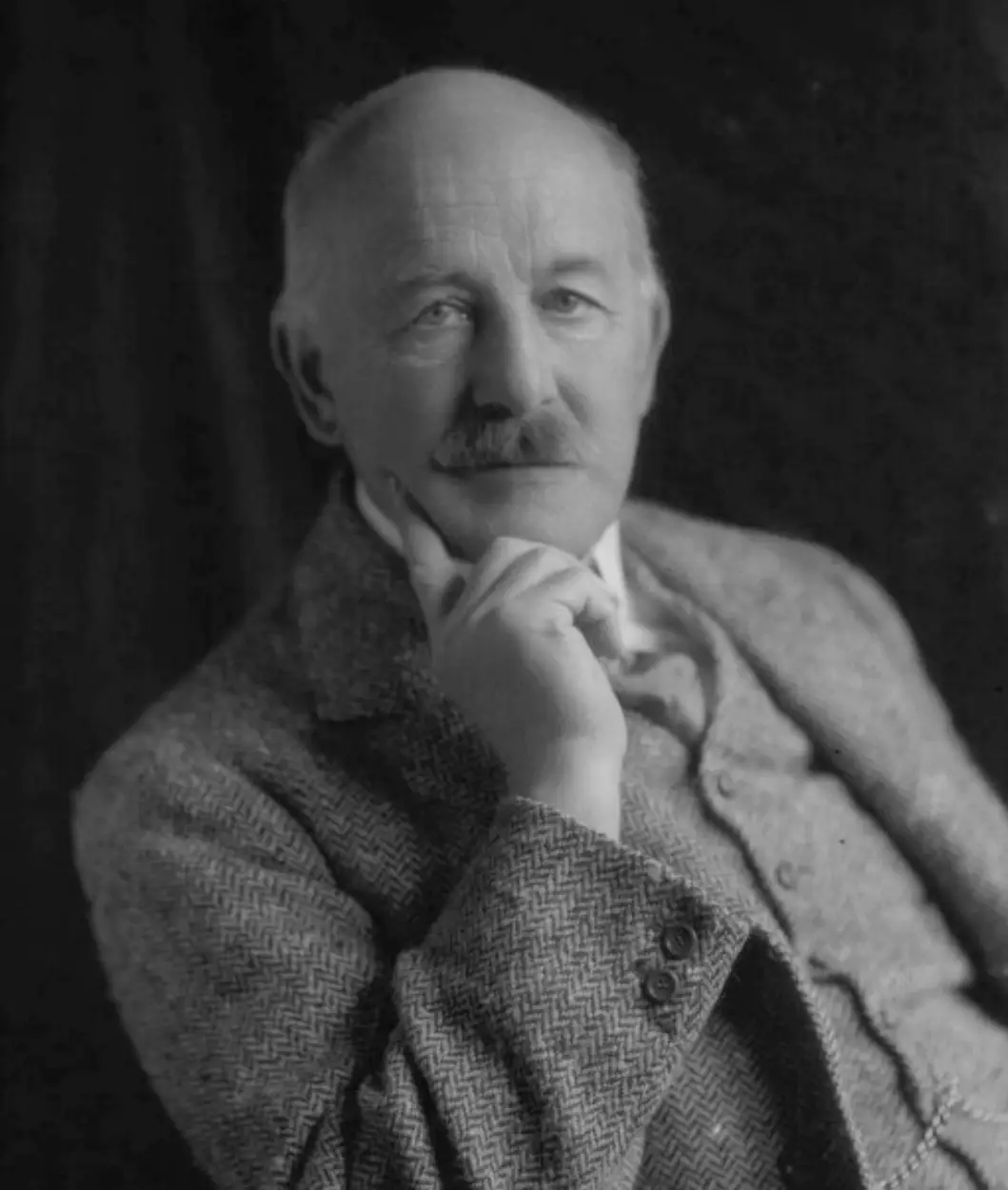
 Philip Hickson Waterlow was born on 30 October 1847 in Hoxton, London, and was the son of Sir Sydney Hedley Waterlow and Anna Marie Hickson.
Note: Further information on Sir Sydney Waterlow is available in ‘Luminaries’ under the ‘People’ section.
In the 1851 census, he is recorded as living with his uncles, James and Samuel Hickson, and his aunt, Mary Hickson, at High Street, Kentish Town, where the brothers operated a wholesale shoe-manufacturing business. He is there as his parents are away at the Paris Exhibition. Philip’s education was latterly at the Mansion Grammar School, Leatherhead, Surrey, but in the 1861 census he is recorded at home with his parents and family at Fairseat House, Highgate.
On 10th June 1869, Philip, then resident in Streatham, South London, married Amy Grace Lutwyche, the second daughter of the late Edgar Lutwyche, at St Leonard, Streatham. He was 21 years old, and his bride was born at Skinner Street, City of London, on 3rd July 1848, and was baptised at St Sepulchre, Holborn, on 2nd August that year. In the 1851 census, she is living in Sydenham Village, SE London, with her father, a leather merchant, her mother, Emily Harriet, and two older siblings. Ten years later, she is a visitor with her mother and a sister at the house of John George, another leather merchant in the High Road, Southgate, Edmonton, in north London. At the time of her marriage, she was living in Lower Tulse Hill, Lambeth. Sir Sydney Hedley Waterlow signed as a witness.
Philip & Amy’s family comprised 2 sons and 4 daughters, and all were registered with the middle name Lutwyche. Philip and Amy established their first marital home at 93 Brecknock Road, Tufnell Park, Holloway, north London, which was listed in directories from 1870 to 1873. They are shown there in the 1871 census with Philip as a Stationer. There are two servants, a housemaid and a nurse for the young Edgar. The Brecknock Road house was a spacious 4-bedroom semi-detached house, rented for approximately £65 per annum; it had a very large dining room and drawing room.
Philip Hickson Waterlow became Chairman of the family stationery and printing company in 1876 and served in this capacity for over 47 years, spanning the period during which Waterlow Brothers and Layton was separated from the parent concern. He became a Director of the Employers Liability Assurance Corporation upon its establishment in 1880 and served there for more than 50 years, until his death. He was elected a Lieutenant for the City of London and served as a Justice of the Peace for the County of Kent. Philip was a Conservative, unlike his father.
Around 1874, the family moved a short distance to an imposing Georgian villa at 240 Camden Road in the eastern part of Camden Town – Kentish Town, where they stayed until 1879. As their family grew, they moved to 30 Carleton Road in Tufnell Park. The 1881 census shows them there, with Philip now “Chairman of Waterlow & Sons, manufacturing stationers employing 3000 hands”. Son Edgar is away at boarding school; a nurse and an under-nurse look after the three younger children. There is also a cook and a housemaid.
By August 1882, Philip had taken a lease on a country villa at Datchet, Berkshire, with 6 bedrooms and 3 reception rooms “very close to the railway station”. They do not seem to have used it much, and he is advertising it to let from that month onwards. In May 1884, Philip voyaged from Liverpool to New York aboard the steamship “Celtic”, presumably on business.
Philip became a Fellow of the Royal Botanical Society in May 1887. During the early 1890s, he was a Director of the South American and Mexico (Mining) Company, but this doubtful-sounding concern, one of many such that attracted British capital at that time, went spectacularly bankrupt in 1894.
Philip’s wife, Amy Grace, died at 2 Hall Road on 29th January 1897, aged only 48. The Amy Waterlow orphanage at Hammersmith, West London, is thought to have been set up by Philip in her memory. After the customary period of grieving, he remarried fairly quickly, probably for the sake of the younger children. His new bride on 7th July 1898 at Marylebone was Laura Marie Jones, daughter of the late Frederick John Jones of Dulwich and his wife Eliza Sophia, born at Clapham, Surrey, in the autumn of 1857, thus almost exactly 10 years younger than himself. She was baptised at St George, Camberwell, on 31st March 1858. Philip’s house at Hall Road was relinquished after Amy’s death, and no longer survives. Philip and Laura moved into a smart London townhouse at 21 Bruton Street, the first residence on the north side of Bruton Street, east of Berkeley Square.
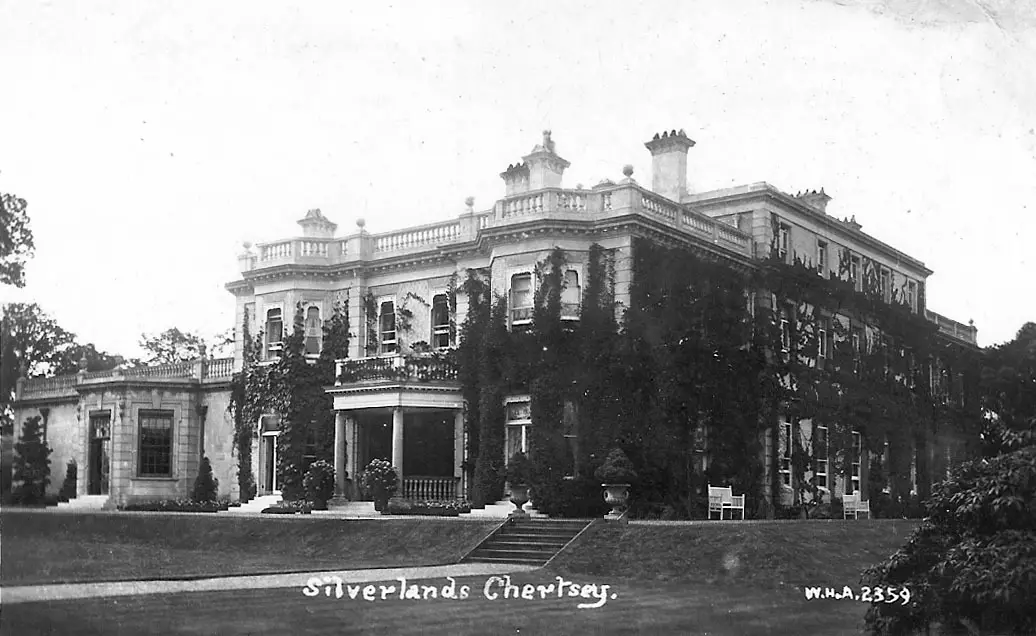
They subsequently occupied a vast country estate of 400 acres, together with a large Georgian mansion, Silverlands, at the top of Holloway Hill near Chertsey, Surrey, and are listed there in the 1901 census. Silverlands Manor is a grade 2 listed mansion house built in 1816 by Robert Porter, a Surrey brewer. The estate was purchased by Vice-Admiral Sir Frederick Hotham in 1825, who initiated significant improvements, with further expansions made later by Sir John Tomlinson Brunner.
During World War II, it served as a nursery/school, later becoming the St. Peter’s Training School for Nurses until the late 1990s. After falling into dereliction, controversial plans in 2001–2002 to convert the site into a clinic for offenders were rejected. The building is now subject to redevelopment plans to restore the structure.
Philip is described as a manufacturing stationer, playing down his role as head of the company; only the three younger daughters are with them now, and they were all later married from the house. There are nine servants, but their individual roles are not listed in the census entry. No doubt there was a similar contingent looking after the Berkeley Square residence. In July 1901, Philip, Laura and daughters Irene & Gladys are recorded voyaging from Montreal to Liverpool on board the “Ultonia”, presumably returning from a holiday. They are attended by a valet and a maid.
Philip was appointed as High Sheriff of the County of Surrey in 1905. He succeeded his father, Sydney, upon Sir Sydney’s death in 1906, becoming the 2nd Baronet Waterlow of London in August the following year, and then soon took over the family country seat at Trosley Towers, Wrotham, Kent, the Silverlands Chertsey estate being sold at auction in September 1907.
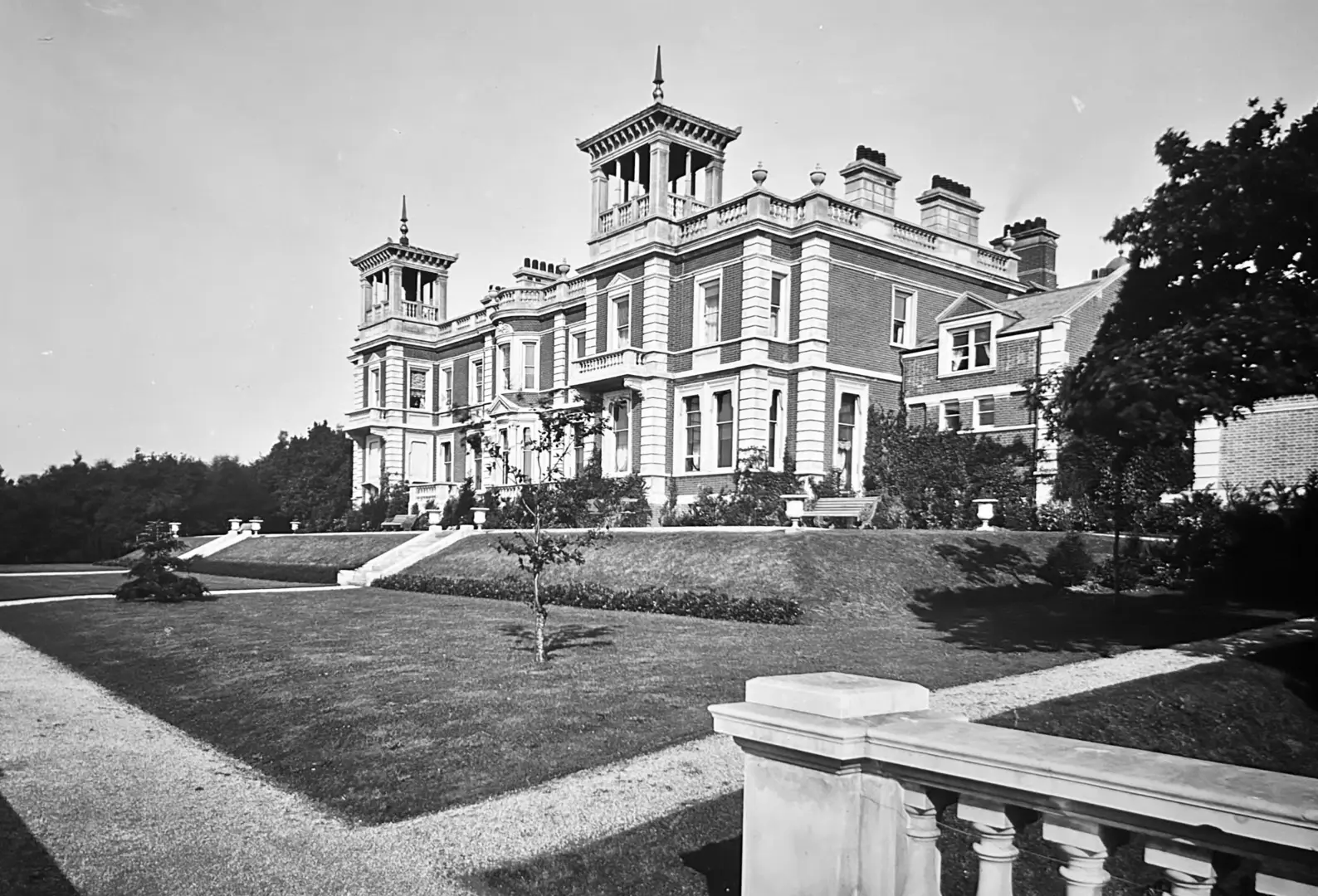
The estate in Kent was to the south of Fairseat and north of the village of Trottiscliffe and extended in an easterly direction towards Meopham, and towards Wrotham in the west. Parts of the southern boundary followed the Pilgrims’ Way, the historical route taken by pilgrims from Winchester to the shrine of Thomas Becket at Canterbury. Locally, the route runs through Otford, Kemsing and Wrotham, north of Trottiscliffe, towards Cuxton, where it crosses the River Medway.
The area was referred to as ‘Trosley Estate’, named after the neighbouring village of Trottiscliffe, which is locally pronounced as ‘Trosley’. The estate is approximately 700 feet above sea level and offers spectacular views over the villages of Trotticliffe and Wrotham, extending to the South Downs. It was on the Westerley portion of the estate where Sir Sydney had built his extensive country mansion, ‘Trosley Towers’.
Note: Further information on Trosley Towers is in ‘Landmarks’ under the ‘Places’ section.
After the end of the Great War in Europe in late 1918, Sir Philip ran an unofficial but well-patronised accommodation agency for returning homeless and injured army officers from a ‘headquarters’ at 24 Carlton House Terrace, offering temporary rooms there whilst more permanent quarters were sought.
Meanwhile, at Trosley Towers, Charles Hammond continued to serve as Philip Waterlow’s butler until approximately 1911, also overseeing the staff and managing the house during his master’s absences. Then, in partial retirement, Charles moved to Hilden House, Stansted, near the church, but he died in November 1922, aged 71, at Lindenwood Villa, a short distance along the Gravesend Road from Trosley Towers.
Despite his will mentioning that he had brought a grave plot at Highgate cemetery and he wished to be buried there with minimal fuss, “funeral expenses not to exceed five pounds”, he was in fact accorded the honour of being interred at the local parish church of Stansted St. Mary, next to other members of the Waterlow family.
Philip’s wife, Lady Laura Marie, died on 27th March 1929 at 24 Carlton House Terrace. This fine house and all its contents were auctioned, and Philip left there in May 1929 to reside permanently at Trosley Towers.
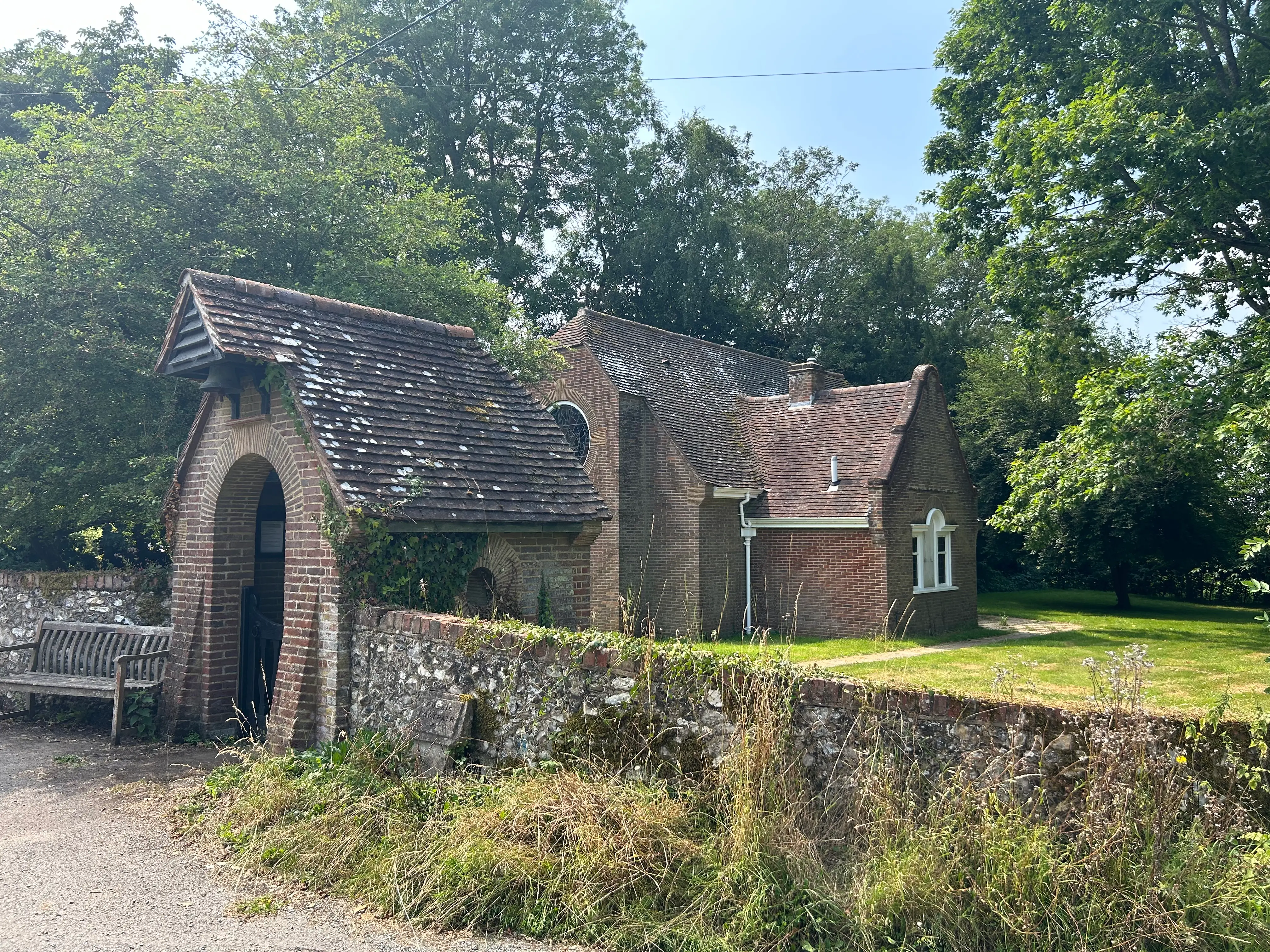
The Church of the Holy Innocents at Fairseat, known as Fairseat Chapel, was built by Sir Phillip in 1930, and the architect was Michael Waterhouse, MC, A.R.I.B.A. A plaque on the side of the building reads ‘Erected for the children of the convalescent home by Sir Phillip Hickson Waterlow, Baronet. To the memory of his wife, his father & his mother and other relatives who lived at Fairseat.’ The Bishop of Rochester consecrated the chapel in August 1930.
Holy Innocents is a small cruciform church built using two-inch soft red stock bricks. The roofs are tiled in deep red machine-made nib tiles with swept valleys and purpose-made hip and half-round ridge tiles. The altar stands in a recess that forms the eastern arm, but the chancel and nave are of uniform width. The south transept contains the pulpit and a single manual organ by Osmonds of Taunton. The north transept comprises a porch and a newly converted kitchen and toilet (formerly the vestry). Beyond the transept is a two-bay nave.
The architect, Michael Waterhouse, commented that Sir Philip wanted the chapel to harmonise with the Manor House and farm buildings, and while retaining its ecclesiastical dignity, to keep some of the domestic character of a chapel of ease, and of the children’s convalescent home, which explained the appearance of the doors, windows, and other architectural features. It could not be any regular ecclesiastical style, but in its proportion and general form, it took something from the Georgian character of the Fairseat Manor House.
The building is the second Chapel of the Holy Innocents at Fairseat, the first being established in one of the farm buildings adjacent to the children’s convalescent home at the Manor House, which was managed by the staff of Sir Philip and Lady Waterlow. The first chapel received many gifts from the Waterlow family, including an American organ donated by Sir Phillip Waterlow, an altar crucifix by Sir Edgar, and a stained-glass window now on the south side of the present church, given by Lady Waterlow in memory of her sister.
Note: Further information on the Church of the Holy Innocents is available in ‘Landmarks’ under the ‘Places’ section.
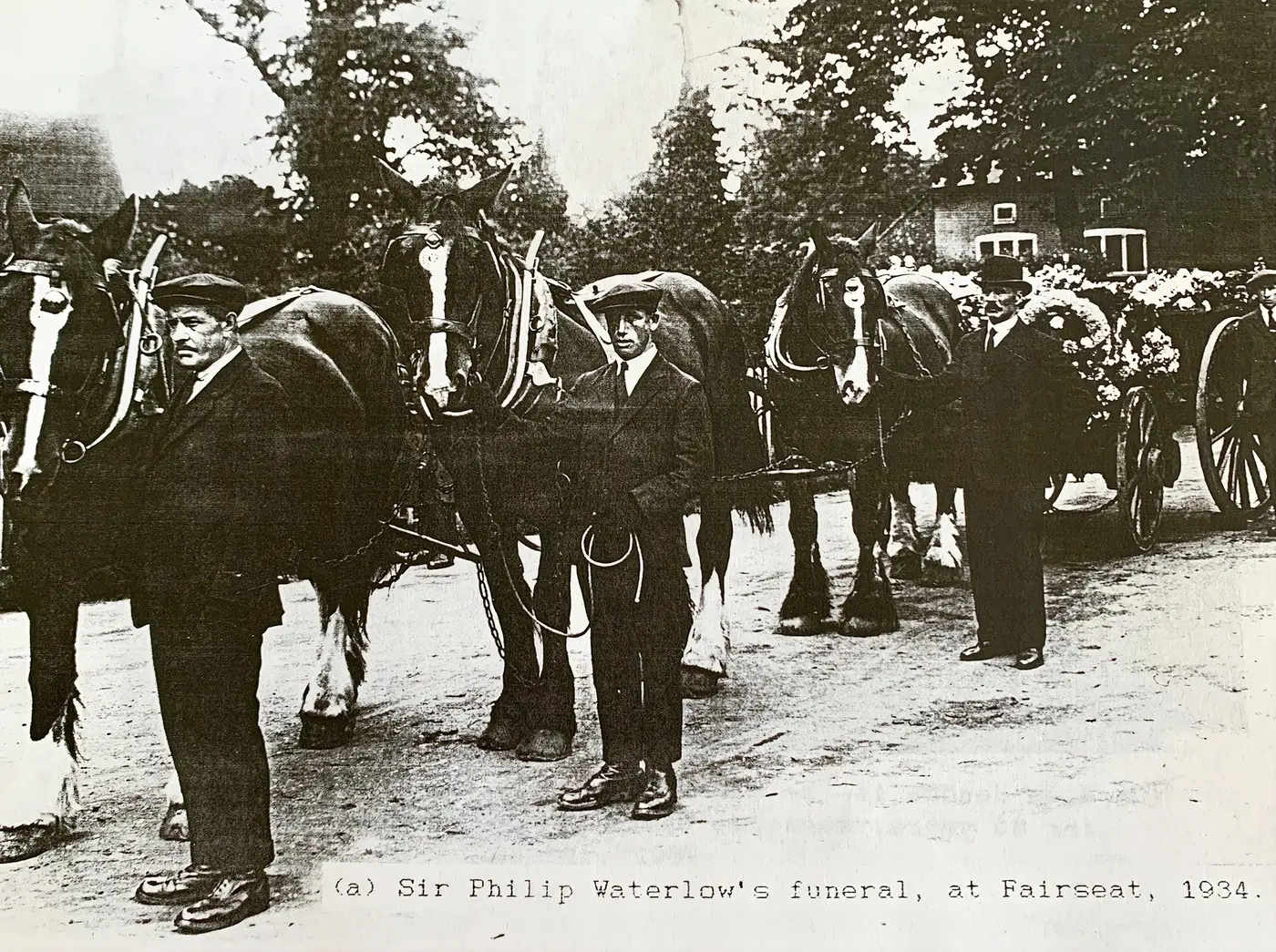
Sir Philip died at Trosley Towers on 20th September 1931, and the funeral service was held in the newly established Fairseat chapel. He is buried in the graveyard at St Mary’s Church, Stansted, and his headstone inscription reads as follows:
To the memory of PHILIP HICKSON WATERLOW, Baronet, who died 20th September 1931, in his 84th year, and his beloved wife, LAURA MARIE, who died 26th March 1929, in her 72nd year.