
With the outbreak of war and the subsequent increase in size of the army, the need for large numbers of suitable candidates to train as officers became apparent. This training was normally undertaken at an Officer Cadet Training Unit attached to the arm of the service in which the cadet would eventually serve. Because each OCTU. was required to ensure fitness and teach basic army skills, duplication of resources occurred; standards varied from unit to unit; and, most importantly, the levels of skill and basic army training of individual cadets varied considerably.
In the early part of 1942, it was therefore decided to standardise this basic training and send all potential officer cadets to a pre-OCTU for up to eight weeks before attending their ‘specialist’ OCTU. With a few exceptions, all officer cadets would now be required to attend this pre-OCTU.
An area of land on the North Downs near Wrotham, Kent, was identified as suitable and was requisitioned by the Ministry of Defence to become ‘Wrotham Camp’. The land was originally owned by the Waterlow family until 1935, when it was purchased by Ezekial Shahmoon, who was a wealthy merchant and bullion dealer of Iranian descent. Under the Waterlows’ ownership, the area was known as the Trosley Towers Estate, where Sir Sydney Waterlow built his country mansion in 1887.
Note: The history of Trosley Towers is available in the ‘Landmarks’ section under ‘Landmarks & Places of Interest.
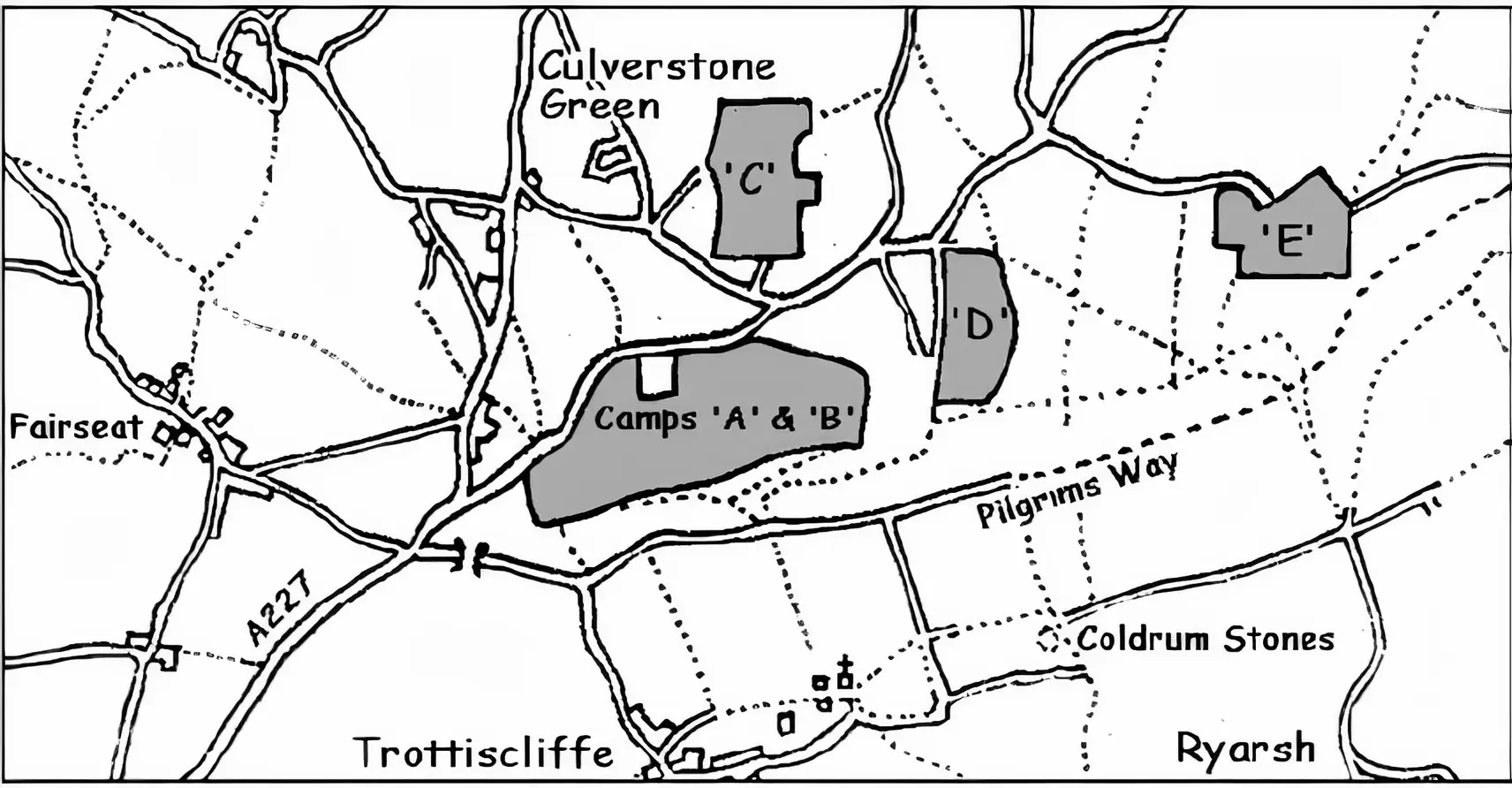
On 20 July 1942, the 148 Independent Brigade Group moved its HQ from Sarre, near Canterbury, to Wrotham Camp and the largest pre-OCTU ever known was officially brought into being. Training areas would extend northwards towards Meopham, and south to farmland beyond the Pilgrims Way. It would handle the vast majority of officers for the British Army for the next four years, up to 10,000 men at any one time.
At this point in the camp’s history, facilities were almost nonexistent. The sewage system was not expected to be completed until the end of September, and units were instructed “that no water-borne latrines be used until orders are given”. In the meantime, the contractors had erected three Nissen huts on each site for bucket latrines, each hut containing twenty-four buckets. Even laundry facilities were scant, and records show that the Royal Berkshires, the Leicesters and the D and M Wing had to arrange for the collection of washing by Messrs Hayes, 129 Coldharbour Lane, Camberwell. All bedding had to be taken by staff, and orders stated that the sleeping quarters of staff and instructors were to be separate from those of cadets. Brigade HQ would be in Hamilton Lodge on the Harvel Road.
Training arrangements at this stage must have been minimal or still being formulated because on the 27th July the Company Commanders paid a visit to the War Office Selection Board (OCTU) at Garston Manor, Watford to see various selection tests for cadets but on the next day, the 28th., the first batch of sixty-five cadets arrived, to be tested and graded the next day. The Brigade, as a pre-OCTU Training Centre, had been launched.
Because of the lack of accommodation at the Wrotham site and the first intake of cadets due at the end of July, work on the construction of hard standings for vehicles and huts had to progress quickly. Loads of rubble from bomb-damaged buildings in London were transported by unit vehicles, and by the first week in August, over three hundred lorry loads had been collected and offloaded.
The grading and testing of cadets would determine the length of time the cadet would have to spend on the course. The experienced Sgt. Major from a front-line regiment would stay perhaps for only one or two days, whereas the civilian or inexperienced private would require eight weeks or more (the courses at Wrotham were designed to bring all officer cadets up to a similar standard prior to entering their OCTU)
Permanent staff and instructors who lived in the area were allowed to return home in the evenings and on weekends, whilst the remainder were either accommodated on the site or billeted in Meopham or Wrotham. For the cadet, it was the Nissen hut. The cadet stayed in the same hut throughout his stay, sleeping in bunks set at right-angles to its length. The ‘furniture’ consisted of a wooden table and two benches. In the centre of the hut was a cast-iron combustion stove, but during the first few months, coal was not issued, and cadets were given machetes and ‘permission’ to chop branches from the surrounding woods.
This first period in the history of the camp must have been a difficult time for both cadets and staff. During the first winter, it was described as an “undrainable swamp” with “swirling mist surrounding dripping trees” and often referred to as ‘Pneumonia corner’. In an effort to brighten up their surroundings, one group of cadets reportedly decorated the approach to their hut with white stones, spelling out, in Greek, a description of their feelings towards the site and accommodation. The CO apparently took exception and, when meting out punishment, intimated that it was given “not so much for the lack of discipline but for the appalling syntax”!
The situation, however, did gradually improve. Work had commenced on the new drill square on what had been a stubble field, and most, if not all, of the amenities for camp life were operational by about this time. A camp maintenance squad had been set up, and the camp perimeter road was swept daily by a mechanical sweeper.
A detachment of Royal Engineers was responsible for water, plumbing, sewage and the laying of supplies when and where needed. Because of the huge increase in traffic in and around the camps, it was soon realised that some local roads were unsuitable, and working parties, including German POWs, made improvements to Harvel Road and Whitepost Lane.
Every day started with physical training done in a singlet and shorts, followed by lectures and demonstrations in a variety of subjects given by instructors in either the Central Hall or out in the field. Field craft areas close to the camp were in ‘Happy Valley’ and night exercises took place in and around Luddesdown, Pilgrims Way, Addington and Ryarsh with a rifle range in the chalk pit, an assault course at the bottom of the escarpment, and 2″ mortar and grenade ranges to the south of the Pilgrims Way. In addition to forced marches up and down the escarpment, cadets would have to march to the Milton Ranges at Gravesend and then run or walk back to Wrotham within one hour.
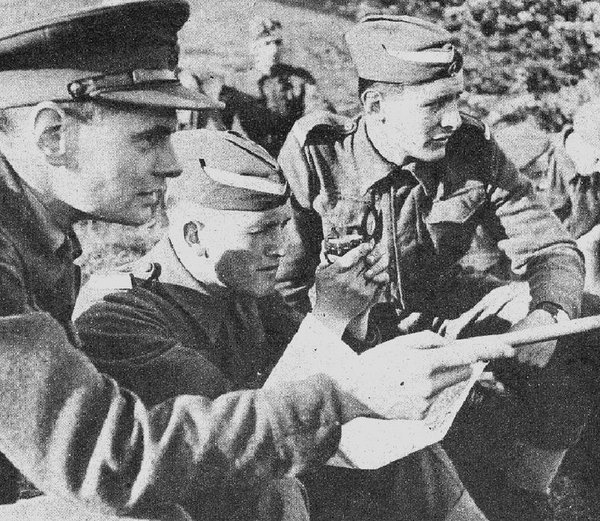
Map-reading exercises took place from a building just below the tree line on the escarpment, the base of which is still visible today. This was followed by one of the highlights of the course and involved a practical map and compass exercise in the surrounding countryside, where cadets followed a route from one map reference to the next, each one being close to a public house, for example, The Cricketers at Meopham and the Green Man in Hodsoll Street to the west of the Gravesend/Wrotham Road.
Halling Quarries were used for demolition demonstrations run by the Royal Engineers and ‘fire and movement’ exercises involving a variety of weapons. At the end of the various ‘legs’, each one devoted to a different weapon, cadets were required to fire live ammunition, often with varying degrees of accuracy. One record states that often they were discharged “only very approximately in the direction indicated by the permanent staff”.
All instruction regarding vehicles was done at the D and M Wing, and this was the last part of the course. The Wing had a massive transport column of upwards of 2,000 vehicles, ranging from 15 cwt. trucks to 10-ton recovery vehicles plus hundreds of motorcycles. These were housed and arm-guarded in the transport lines and workshops on what is now the rugby field at Vigo. As well as instruction duties, this wing was also responsible for all vehicles, transport and motor repairs and maintenance.
Ministry of Transport examiners visited the camp once a month to examine the ‘L’ drivers on a fairly stiff test, and those who passed were rewarded with their Army Driving Licence and certificate. The same procedure was followed for the maintenance side. Motorcycle training on 500cc Nortons was also carried out here using the figure-of-eight cinder track behind the Central Hall, progressing to convoy runs via Cobham, Gravesend and Longfield. The final test was ‘rough-riding’ in the quarries or in the woods near lghtham.
As well as being used for training lectures, Central Hall (later known as Erskine Hall after Brigadier Erskine, the C.O. from January 1943) also showed films, held boxing tournaments, and hosted ENSA shows. Terry Thomas, Gracie Fields and Vera Lynn appeared in a variety of shows and concerts were performed by, amongst others, the BBC Theatre Orchestra. Dances were also held here, and although ladies were in short supply, coaches were provided to transport some dancing partners from Gravesend and District, WRENs from Chatham, nurses from Preston Hall and Land Army girls and WRAFs from West Malling.
The local pubs and village halls were often visited, and the Vigo Inn provided good beer and darts and skittles with the locals. The Cricketers was also popular, and a collection of cadets’ regimental badges adorned the walls. Dances were also held at Meopham Village Hall on Wednesday evenings, and many ex-cadets still wonder if the famous ‘Meopham Blonde’ or ‘Cap Badge Kate’ are still around, both apparently the talk of officers’ messes the world over!
The invasion of Europe would involve huge numbers of men and equipment. Wrotham Camp was to house units of the Canadian Army. An area was set aside within the Wrotham site for a tented camp, and all over the South of England, deceptions were put in hand to mislead the enemy as to the true size and position of Allied troops and their ultimate landing areas on the French coast.
Dummy airfields were constructed, along with fake aircraft, convoys, and troop concentrations. On the 10th March, all movements, communications, and mail were subject to strict censorship and control, and up to 2/3 of Kent was to be ‘out of bounds’, with the District Councils of Gravesend, Malling, Dartford, and Northfleet classified as restricted areas and banned from visiting.
D Day came and went, and the only mention of probably the most important phase in the whole of the war merited only one line in the camp record “June 6th 1944: second front opened”.
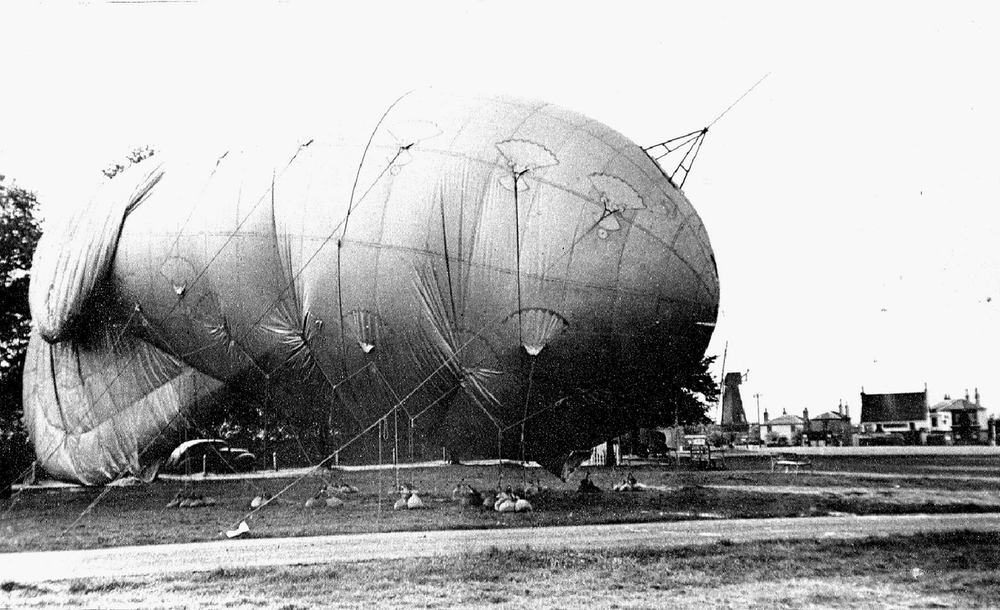
Fighter aircraft were deployed over the Channel between Beachy Head and Dover, along the coast between Dover and Newhaven and inland between Haywards Heath and Ashford. At night, the fighters were radar-controlled and were aided by searchlights positioned every 1 1/2 miles from South Foreland to Seaford in Sussex. 384 light and heavy AA guns were deployed along the North Downs, and 480 barrage balloons on the higher ground behind them.
By June 1945, the number of officer cadets in all OCTU camps in the U.K. was only some six hundred per month, and the cadet population at Wrotham had fallen to between 1,200 and 1,800 at any one time. The decision to abolish the Brigade was taken on the 8th April 1946.
After its closure, the site was occupied for some time by squatters, and Erskine Hall was used as a store by the Ministry of Transport and then by a theatre company until its demolition in 1969 to make way for Vigo Village School playing field.
Today, little is left of what was at one time the largest pre-OCTU in the world, only the outlines of some of the foundations in the surrounding woods and a crumbling assault course wall at the bottom of the escarpment. One large building remains at the back of Vigo School, and with its large, rusting double doors, it was probably part of the motor transport garage facilities of ‘B’ Wing. Also remaining is the old Brigade HQ, Hamilton Lodge on the Harvel Road.
The only other reminder left today is in the name of one of the main roads running through the village of Vigo (built on part of the site in the 1960s), Erskine Road, named after the Commanding Officer of the 148 Training Brigade from January 1943.
These then are the only lasting reminders of a camp through which passed many thousands of cadets destined for commission in the British Army.