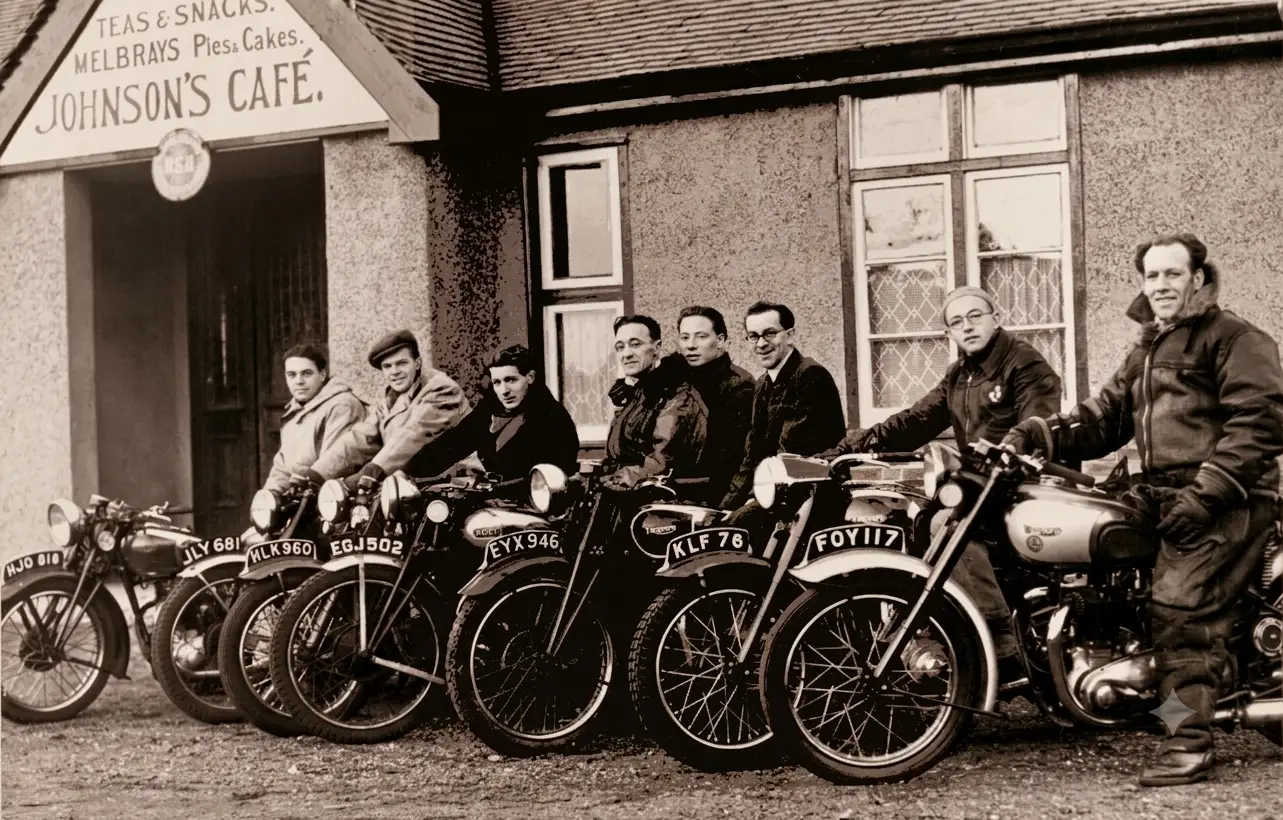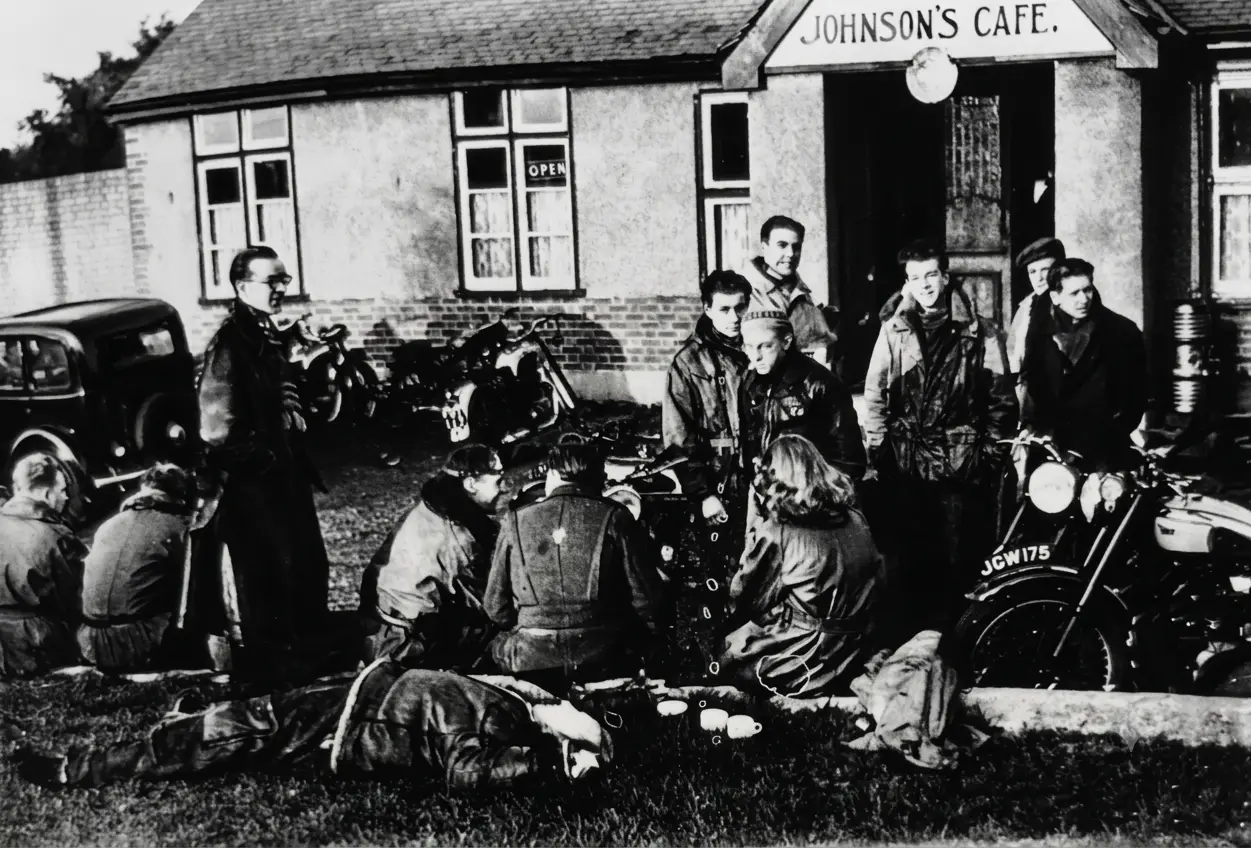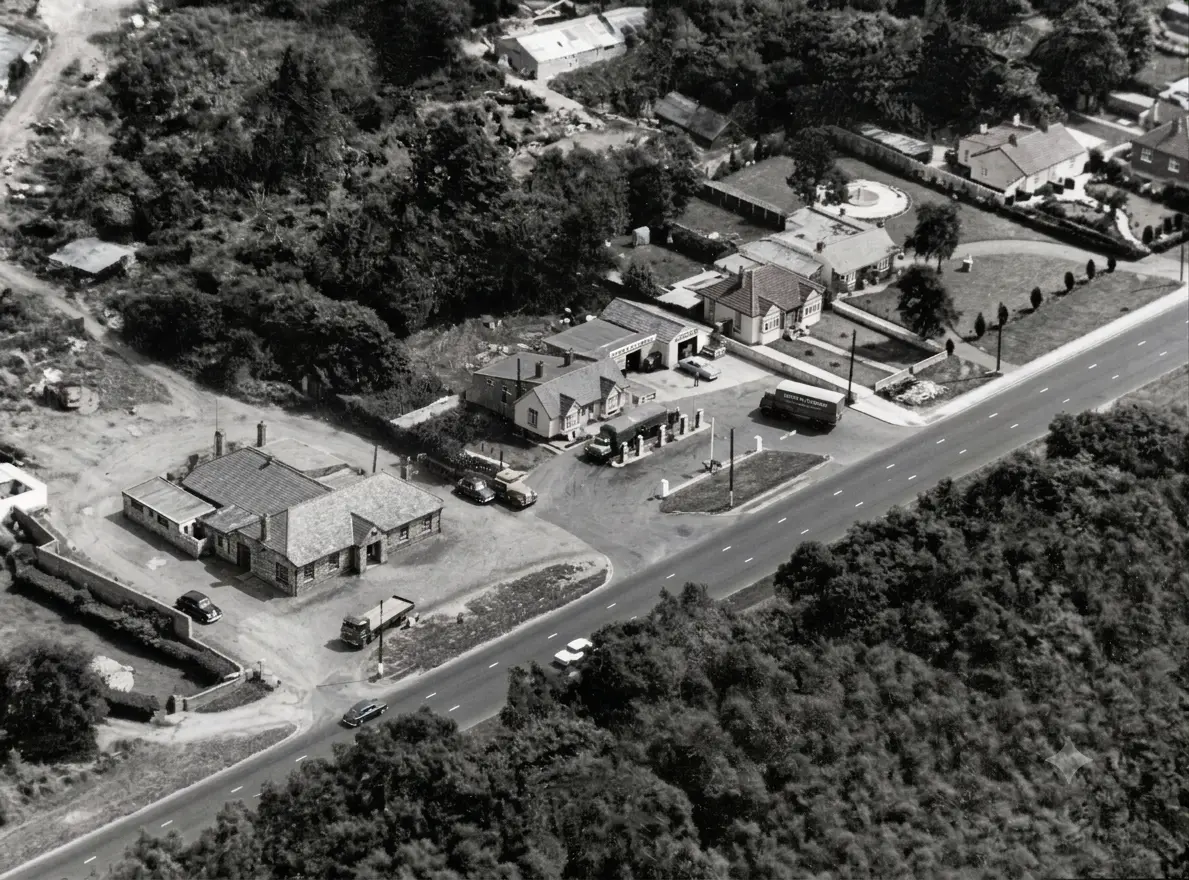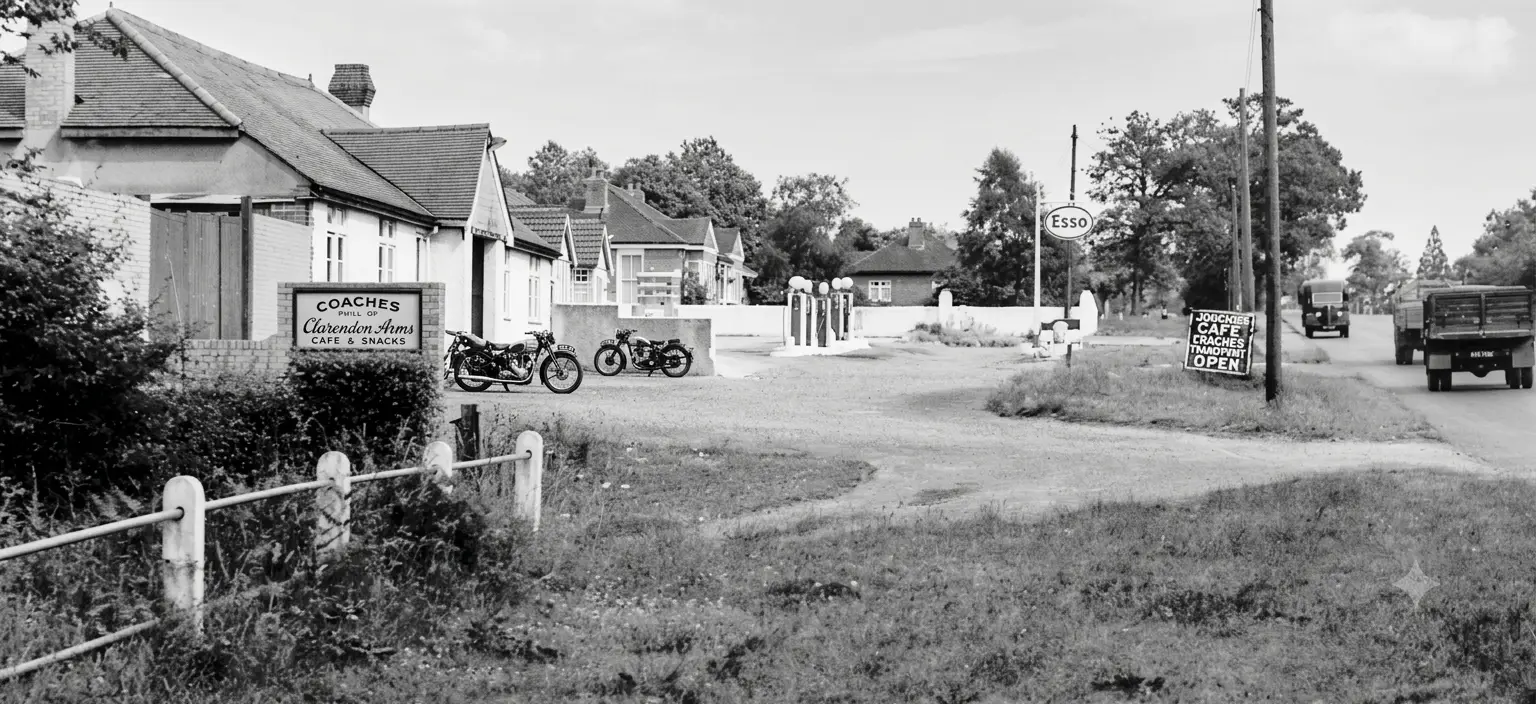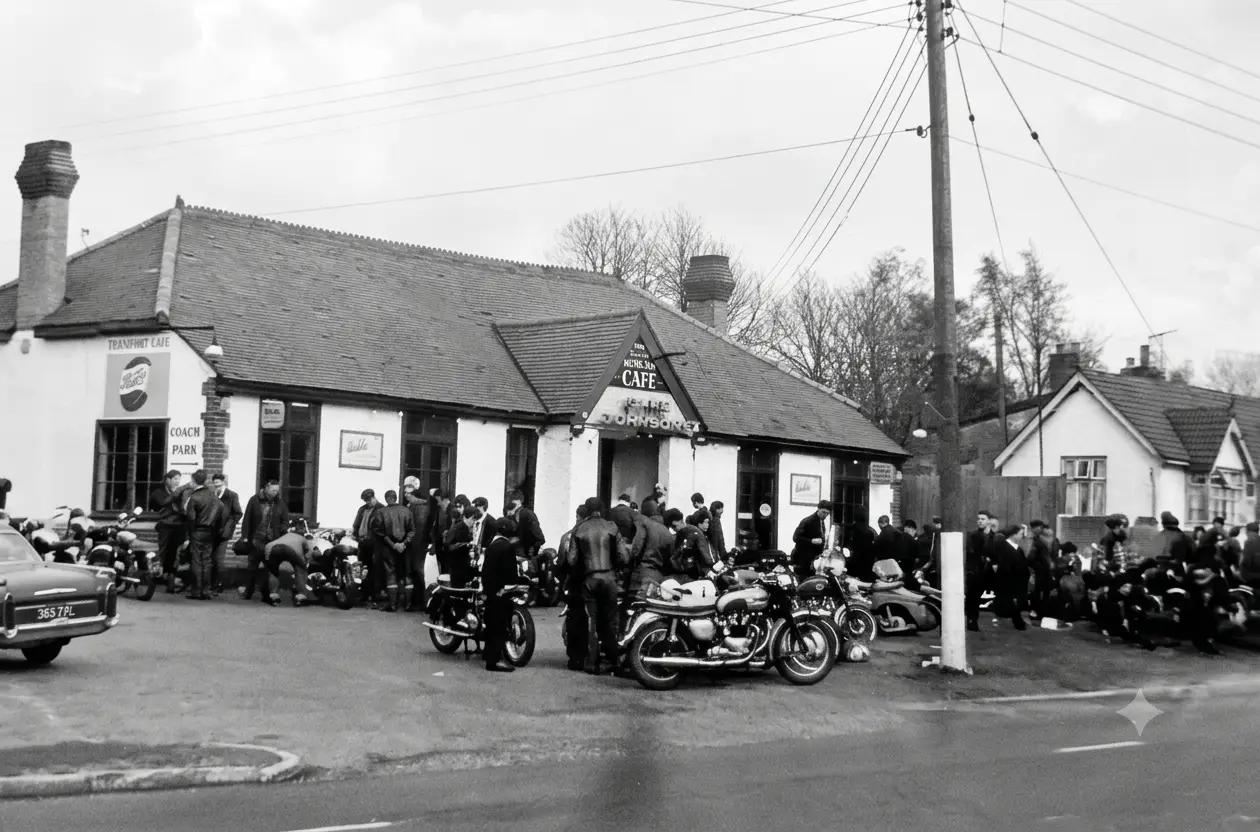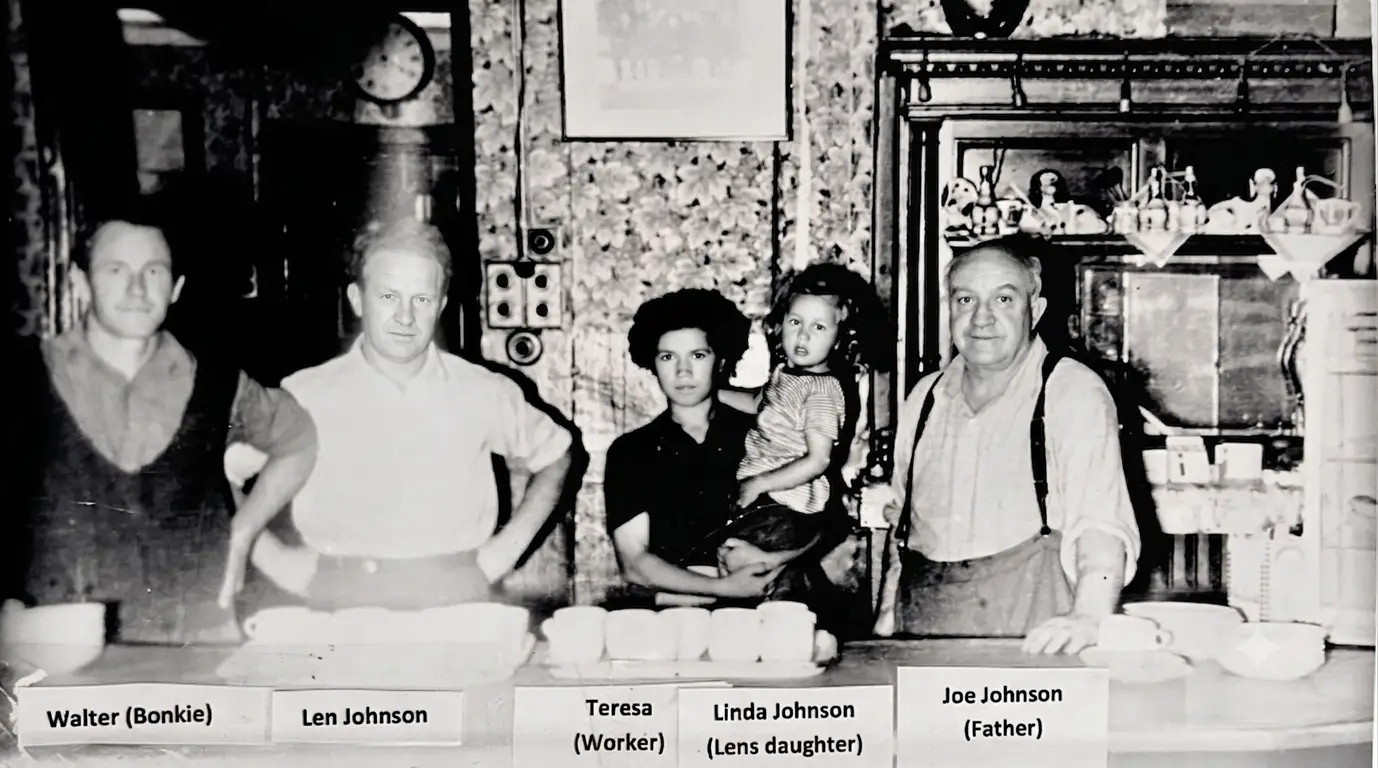
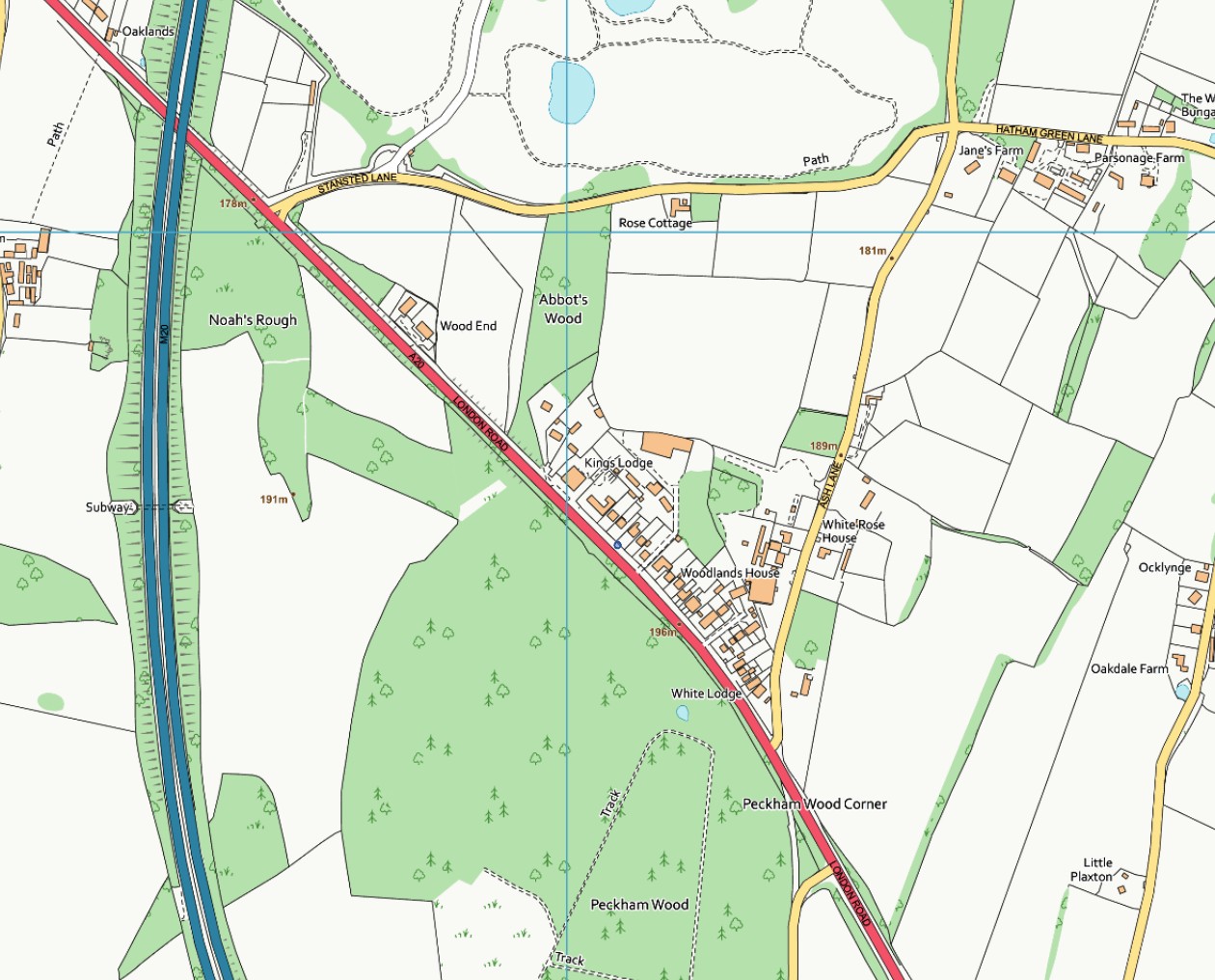
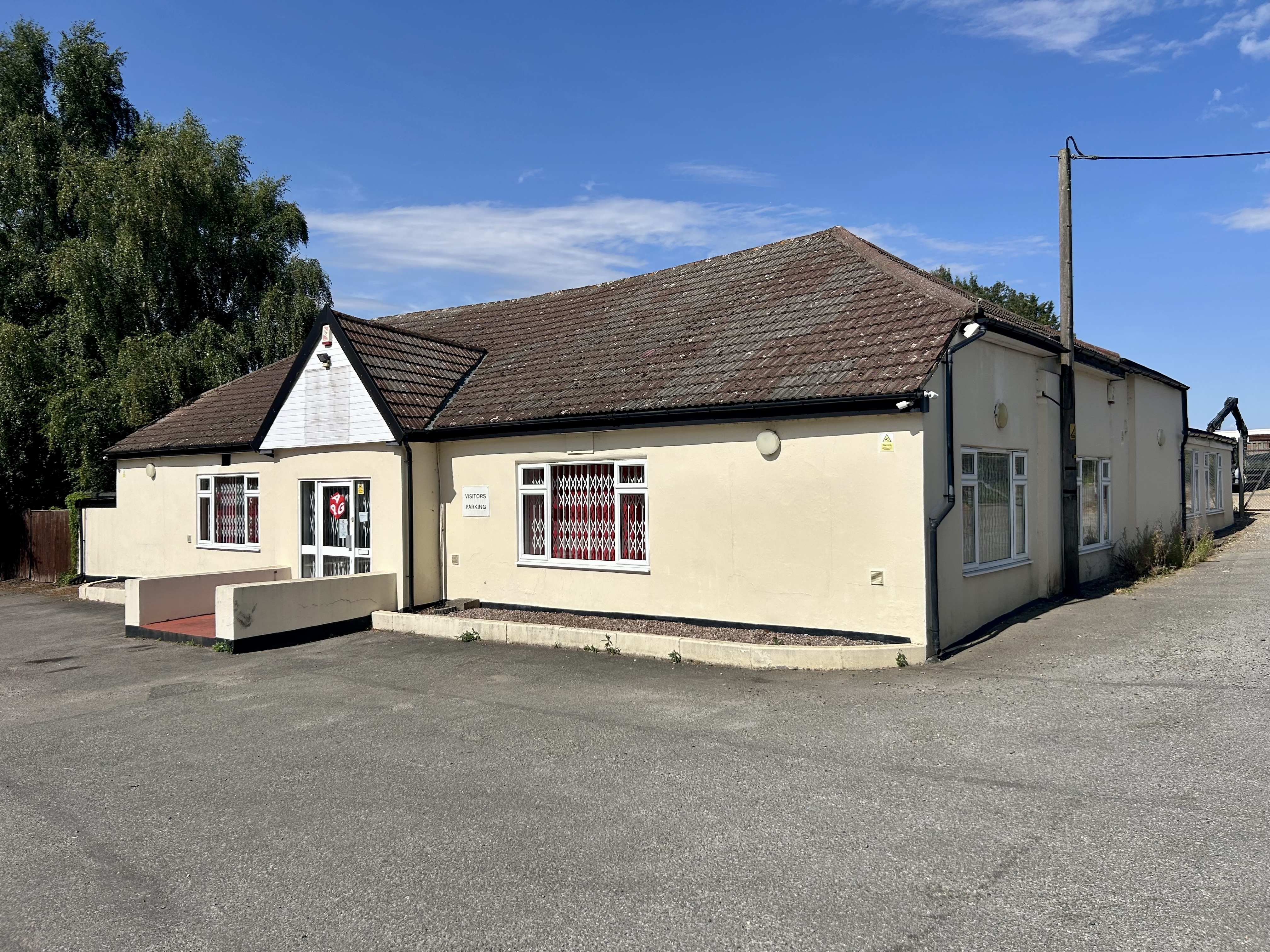
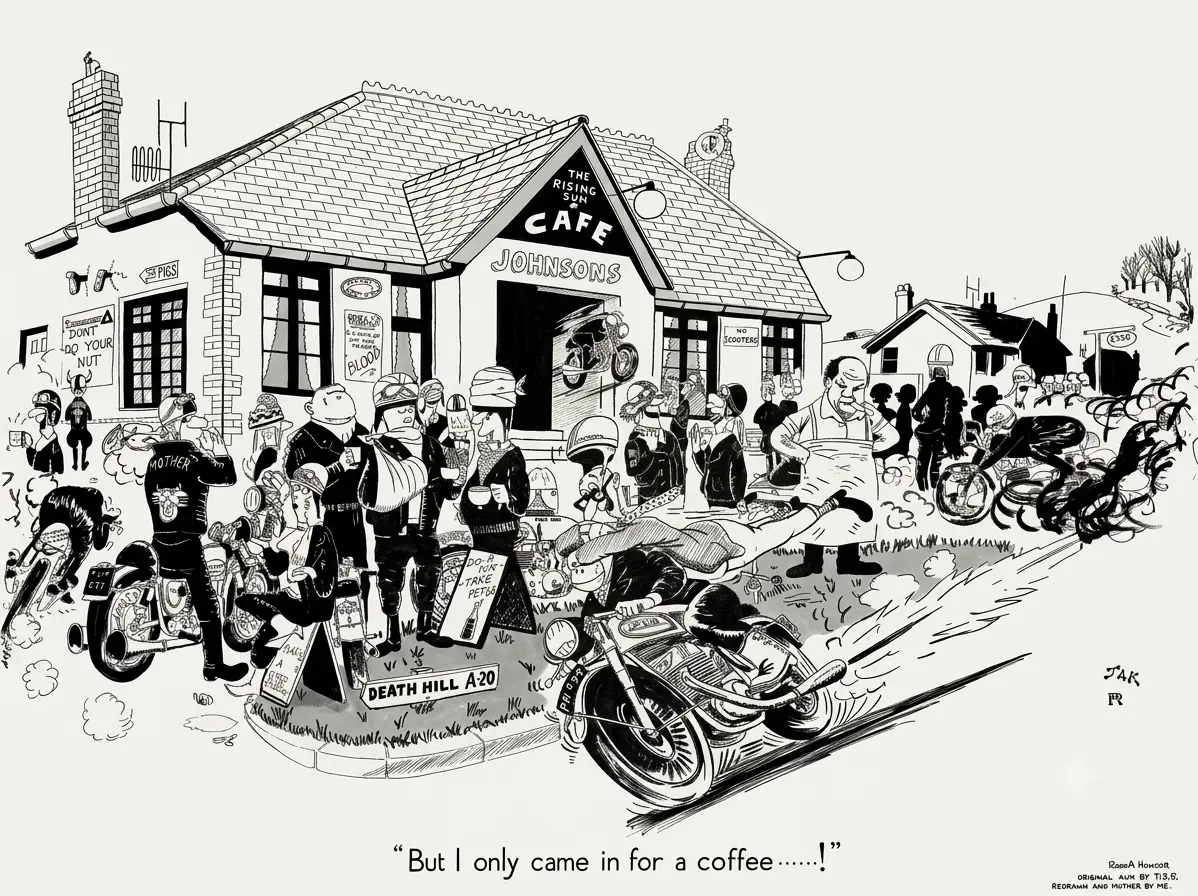
Johnson’s cafe was a major meeting place for motorcyclists. The café was in a building on the A20, which still exists, about 1 mile east of Brands Hatch. The A20 was then a major route from London towards the Kent coast, and its proximity to Brands Hatch also attracted motorcyclists going to and from race meetings. At weekends, enormous numbers of riders gathered there, and one contemporary recollection describes nearly 1,000 motorcycles parked around the café on a Sunday in 1959.
It is about half a mile outside the Stansted parish boundary but is included on this website as its presence and reputation are still strong memories for many villagers. The building was built in 1928 and was originally called the Rising Sun tearooms. Its current postal address is Kings Lodge.
After it ceased operating as a cafe, it became a nightclub (Oscar’s and then King’s Lodge Disco among others). The nightclub closed in 1993, and the property stood vacant for six years until it was acquired by Stephen Hill Accountants as offices. That company became A4G LLP Chartered Accountants and subsequently moved a few miles down the road to Nepicar House, Wrotham Heath in 2026 after 33 years in occupation.
The café started becoming a venue for bikers in the late 1940s/ early 1950s when the ‘London Ton Up Boys’ started visiting on their motorcycles capable of doing more than 100mph. These included BSA Gold Stars, Triumph Bonnevilles, Norton Dominators, Norton Manxes, Vincents and Royal Enfields.
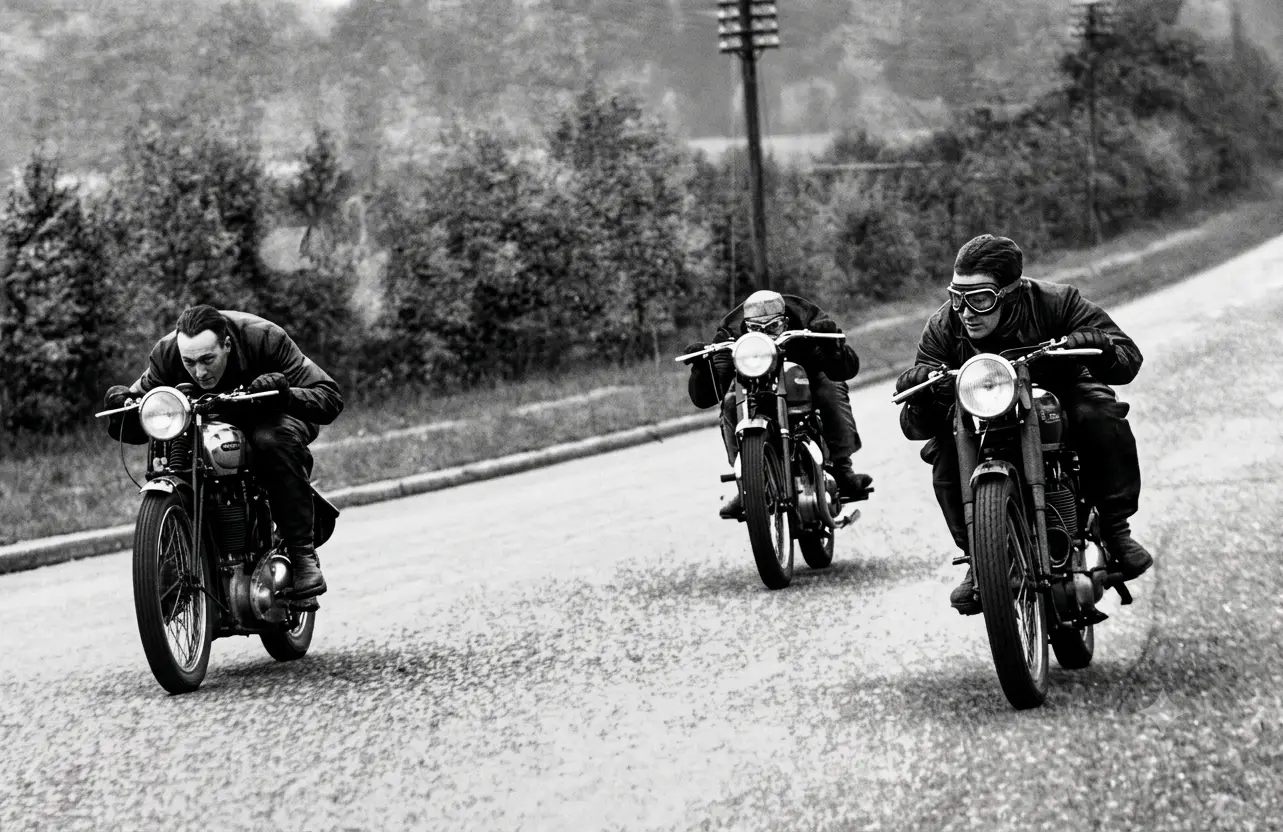
It was also a place to race and socialise. Memories from the period describe groups leaving the café late at night and making high-speed runs along the surrounding roads. In particular was “The Challenge”. This is the story that seems to have given Johnson’s Café its legendary reputation.
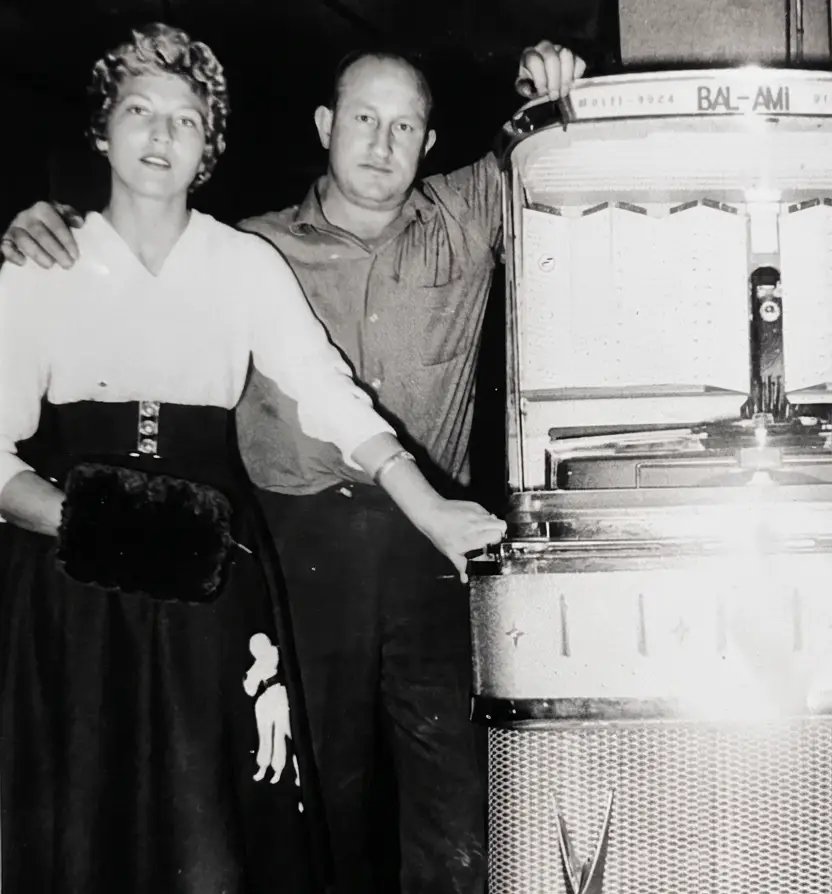
‘The Challenge’ involved a biker putting a record on the café’s jukebox, then attempting to ride west along the A20, past Brands Hatch to the roundabout at Farningham and return before the record finished. The distance from the café to the present Farningham roundabout and back is about 8 miles. If a rider averaged 120 mph, it would take 4 minutes exactly to cover that distance. This suggests that the challenge was rarely beaten.
Of course, this did not stop young men trying, and the road towards Farningham subsequently acquired the nickname “Death Hill”, because of the accidents associated with these races. Its current, less gruesome, name is Gorse Hill.
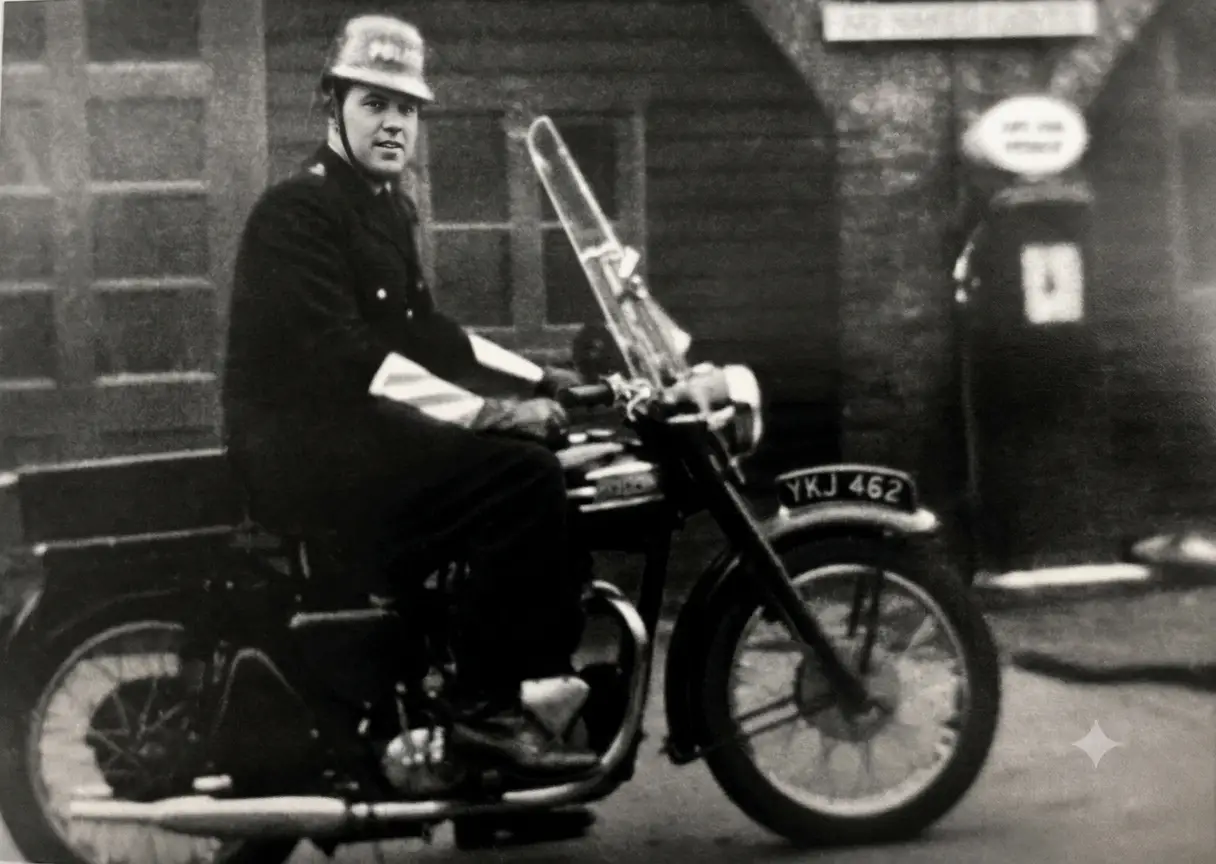
If this sounds all borderline lawless, then that view needs to be tempered by the account of Laurence Goble, who was a motorcycle policeman in 1958 and whose area covered Johnson’s cafe. He says “We could always get a cup of tea round the back when we were not trying (sometimes successfully) to keep ‘the hoods’ within the bounds of the Road Traffic Act. Some of the patrons may remember the road safety film shows which the Police ran in Chatham for motorcyclists.”
The café itself was substantial and had seating for about 140 people. An account written in 1999 described it in 1959 as “when you entered the main door, standing in its prominent position in the centre but left of the room stood the jukebox, never silent. Behind the jukebox in the far left-hand wall was an open fireplace burning logs – a very welcome sight on a cold winter’s evening. On the right of the main entrance stood two football machines always fully manned. Right in front of you through the entrance stood a big man in a striped T-shirt, his
jeans held up with a wide belt with a big buckle. He was known as the Pirate, and he stood behind the counter and asked us what we wanted to eat and drink. The choice was tea, coffee or Coke, and the food was Telfers meat pies or toast. The room beyond the Pirate housed the snooker table; if you wanted quiet, this was the room you went to. Above the fireplace, pinned to the wall, was a map of the south of England. On a Friday, one of the biker’s girlfriends would be blindfolded, and she would point to a spot on the map. Wherever she pointed, we would ride to that weekend.”
The same source also described the women who went to the cafe: “The girls who went to Johnson’s came from all walks of life. A lot of them were studying for careers at technical college. They had to be as hard as the bikers, and they rode with us in all weathers, rain, snow and the freezing cold of the winter. Some of the girls could really ride the bikes. I remember one Boxing Day, a group of bikers came to Johnson’s wanting to race us. We threw our keys to the girls and said to the visitors. If you can beat the girls, we will race you. Three girls rode out on Triumphs, followed by the visitors. They turned left out toward Wrotham Hill, and when we all went out to watch a few minutes later, we first heard the roar of bikes as they came back. Our girls were way out in front, and the visitors carried on back to where they had come from. The girls were greeted with cheers and a well-deserved coffee. In most respects the girls were like us – they too wanted the freedom from home life and the chance to travel out into the country and coast at weekends.”
The premises were seriously damaged by fire in 1976 and were partially rebuilt, but still in their original single-storey form.
The cafe has become sufficiently famous that Japanese motorcycle enthusiasts still visit the site looking into its history and the available photographs from the past. The previous occupants have described Japanese visitors arriving dressed in 1950s biker clothing specifically to have their photographs taken there.