
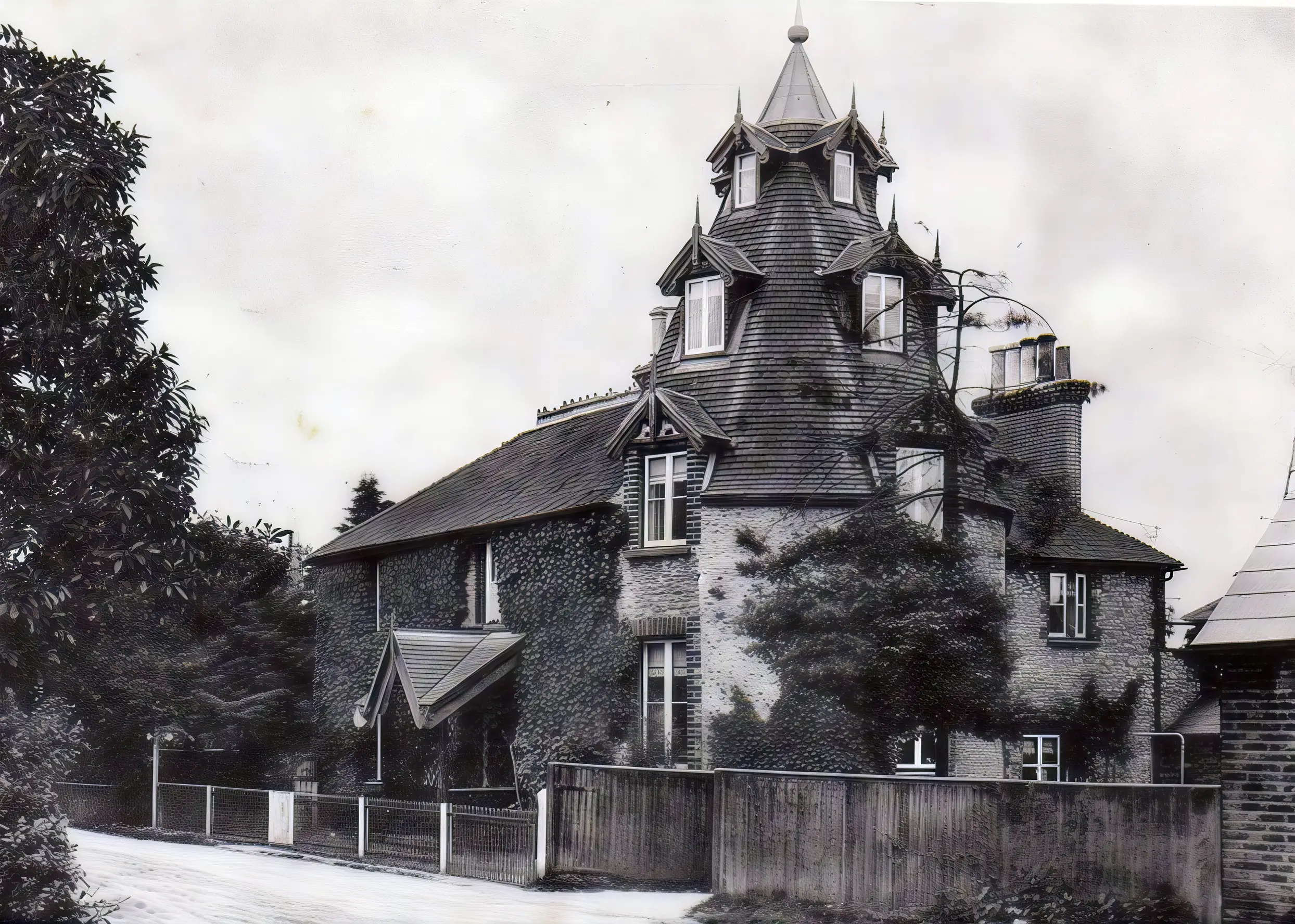
The original photograph shown above is thought to have been taken by Mr W Parsons, who ran the village stores in Meopham Green. The original picture was titled ‘Ye Old Hop Oaste’, which was probably a title chosen by the photographer to give a sense of antiquity and does not reflect the historical name of the building.
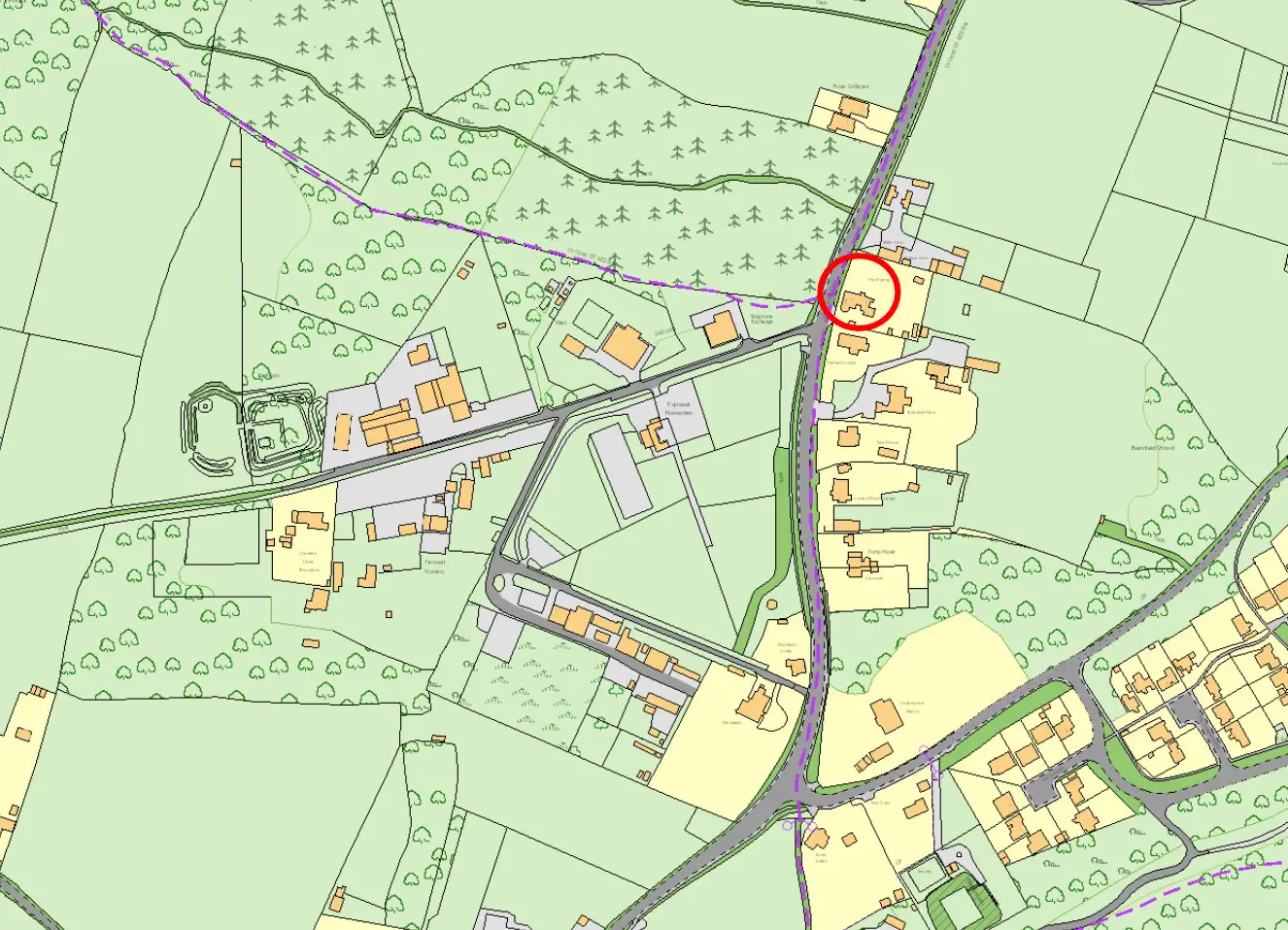
In the 1881 census there is nothing that draws attention to an oast house in this location, just a farm of 147 acres with two buildings: Ivy Tower and Ivy Tower Cottage. Albert Saunders was the farmer, and he lived in Ivy Tower. He employed eight men and a boy who lived in both properties. They included a shepherd, a waggoner, four farm labourers, and their families. At some stage the freehold of the farm had been purchased by the wealthy Waterlow family from Trosley Towers. By 1896, the Ordnance Survey map showed the farm as Miller’s Farm, and in 1903 the Waterlows converted the oast on the farm into a residential dwelling. In 1910 Ivy Tower Farm and Miller’s Farm were both referred to by the Inland Revenue as if they were the same property.
The Folly Flâneuse runs a website about follies. The owner of the site has been fascinated with follies since she was a child, and the following is an extract from her website about Tower Folly:
“It is common today to see former Oast Houses, originally built to dry hops, converted into chic Kentish dwellings. The Waterlow family of Trosley Towers, near Wrotham, are credited with being amongst the first to see the capabilities of such redundant structures when, in 1903, Sir Philip Waterlow (1847-1931) converted the oast house on his family’s estate”.
Sir Sydney Waterlow died in 1906, and the Trosley Towers estate passed to his son, Sir Philip. For the time being, nothing changed, as we know that the Waterlows had a farm steward running the farm and occupying “the Hopkell House at Millars Farm.” In Kent at the time, ‘Hopkell’, ‘Hop Kiln’ and ‘Oast House’ were interchangeable terms, so it seems that this was a previous name for Tower Folly. This situation continues in 1910 with the addition of Charles Gilbert, the coachman at Trosley Towers, and George Underhill. A 1920’s map mentions ‘Tower Grange’ as being on this site.
After Sir Philip Waterlow’s death in 1931, the Trosley Towers estate became surplus to the requirements of the Waterlow family and was sold in lots. On the 1932 sales map of Trosley Towers, the site is named as Miller’s Farm.
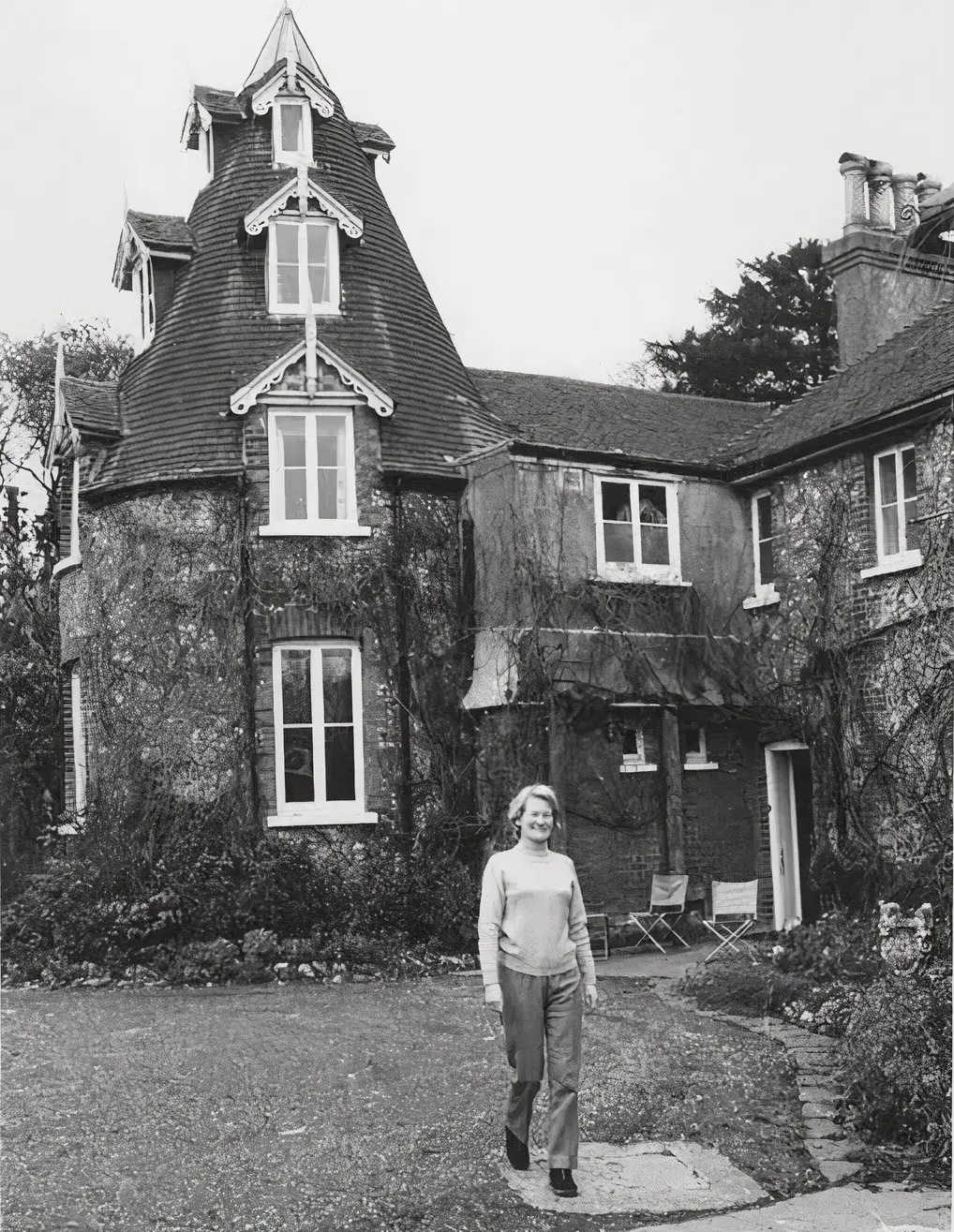
The sales records of the old Trosley Towers estate are difficult to come by, but there is a suggestion that Miller’s Farm may have fallen into the same ownership as the nearby Rose Farm. What is clear is that by January 1959 Daphne Oram took up ownership and occupation. Her own papers record that she resigned from the BBC in January 1959 and moved to Fairseat to establish herself at a building which she renamed Tower Folly and set up Oramics Studios.
Note: A full history of Daphne Oram can be found at People>Luminaries>Oram, Daphne.
The Folly Flâneuse continues, “In 1959 a new resident arrived, complete with some ultra-modern technology. This was Daphne Oram (1925-2003), who promptly renamed her new home Tower Folly. Oram was a pioneering electronic composer who had co-founded the BBC Radiophonic Workshop. In the seclusion of her studio in Tower Folly, she invented the ‘Oramics Machine’, a means of synthesising sound by drawing waveforms, pitches, volume envelopes and other properties on film.
A Daily Herald journalist visited Daphne Oram in 1962 after she had been awarded a grant of £3,550 by the Gulbenkian Foundation to ‘further her research into electronic music’. The journalist, yet to be converted to ‘space age music’, was relieved to find that ‘blue-eyed’ Miss Oram was ‘not in the least like a crank or an egghead’. Baffled by what he heard, the reporter went for the human interest angle: the local policeman had been told to ignore any ‘shrieks’ coming from the ‘house of strange sounds’ – they were not the cries of Oram in distress, but indicated that she was hard at work on her latest composition.
The windows have been replaced since the postcard view of her outside the Folly was taken, and sadly the pretty pinnacles on the gable above each window have been truncated, so the building has less of the air of a ‘Swiss pagoda on ecstasy’, as it was so memorably described by Headley and Meulenkamp in Follies, Grottoes and Garden Buildings in 1999.”
Daphne Oram died in 2003, aged 78, and Tower Folly was sold on the open market. In 2004, planning consent was granted to divide The Grange (including the Roundel) into two separate semi-detached dwellings known as No. 1 and No. 2 The Grange. No.1 comprises the building known as Tower Folly and fronts onto Gravesend Road. No. 2 comprises two attached blocks and sits behind No. 1 on a large plot.