
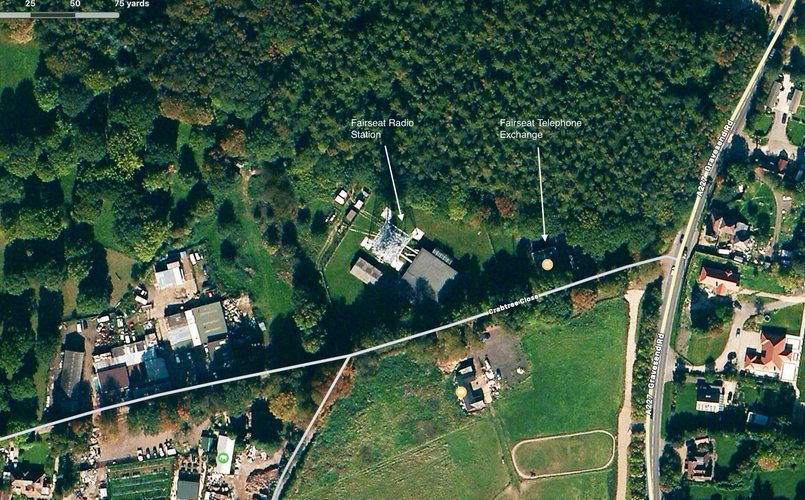
Image courtesy of Google Maps
The telecommunications tower is located on the bridle path from the A227 to Fairseat, Kent, and was constructed in 1965 on land purchased from Frank King, the then owner of Woodbine Farm. The site would also become the location of the current telephone exchange, although there are no direct links between the two facilities. Resident John Deacon was the Engineer-in-Charge of the Station for 12 years, and he provided much of the material for this article. Brenda Cook (née Burns) from Fairseat was the cleaner at the radio station.
The Post Office Telephones initiated the building as part of a series of microwave links from the London Post Office Tower. The main route was from London Tower, with repeaters at Fairseat and Flimwell, to Tolsford Hill near Folkestone. The system provided telephone circuits and television links to Europe:
The telephony was forwarded to Europe via radio and submarine cables at St Margarets Bay.
Television was sent to Europe via radio and also fed to the Dover broadcast transmitter for the main ITV and Channel 4 by coaxial cable.
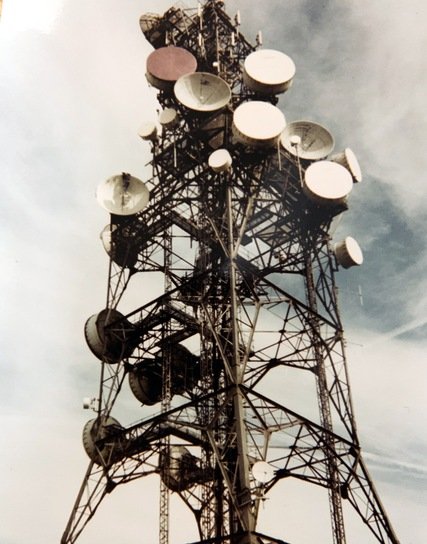
Image courtesy of John Deacon
The first system installed at Fairseat was a 2Ghz GEC link capable of carrying 600 telephone circuits with main and standby channels. This system connected to Kelvedon Hatch near Ongar, Essex. At Fairseat and Kelvedon, the telephony was routed onto 24-circuit carrier cables, and a further radio link carried on to Stokenchurch near High Wycombe via Pimlico. This link was part of the Backbone Network set up to provide resilient communications in the event of nuclear war, and the site at Kelvedon also had a secret underground nuclear bunker.
The tower was operational by 1966, but Flimwell was not completed until 1969. For the 1966 World Cup, the BBC set up a temporary link from White City Television Centre to Folkestone via the Fairseat facility.
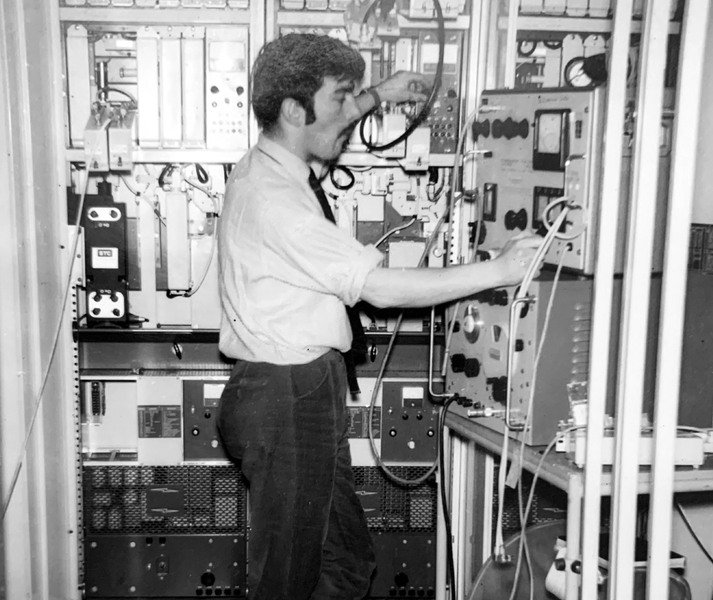
Image courtesy of John Deacon
At the time, John Deacon worked for the Post Office in Tunbridge Wells and lived in Hastings. When he became Clerk of Works for the installation in Fairseat, he wanted to avoid such a long commute. So he rented a nearby derelict bungalow that had previously been lived in by Mr Crouch (of Fielden and Crouch’s Nursery). Later, he bought the bungalow and, as of 2020, still lives there.
In the late 1960s, Thames radio was also installed. This was a ship-to-shore VHF maritime link covering the Thames estuary and had two telephone channels, with channel 16 used for emergency and setting up calls via operators at North Foreland. The calls would then be transferred to channel 27 to connect into the network. The equipment used Marconi thermionic valves and was operated remotely by landlines from North Foreland.
In the late 1960s the first London-Folkestone systems were installed. These were STC lower 6GHz equipment, solid-state, with a travelling wave tube as transmitting power valve. There were initially two channels carrying television, Eurovision and the main ITV channel to the Dover transmitter. A further two channels each carried 1800 telephone circuits; there were also two standby channels which could be used for occasional television use when not used for failure or maintenance purposes. In 1981 this system was expanded to its maximum capacity with telephone channels and a Channel 4 television link.
In the 1980s, further links were added in the 4GHz, upper 6GHz, and 11GHz bands; the 11GHz being the first digital system, and there was a large increase in television links when the TVS studio opened in Maidstone in 1982. The television channels were carried on radio links to the Maidstone telephone exchange and on to the studio via coaxial cables. Digital radio, the last system, did not perform well. At this time, Optic Fibres were starting to be used extensively, and this was the end for radio links that could not compete on reliability and cost. From 2000 onward, the analogue network was turned off, and the traffic migrated to the fibre optic network. The tower is now used mainly for mobile phones and low-capacity line-of-sight links.