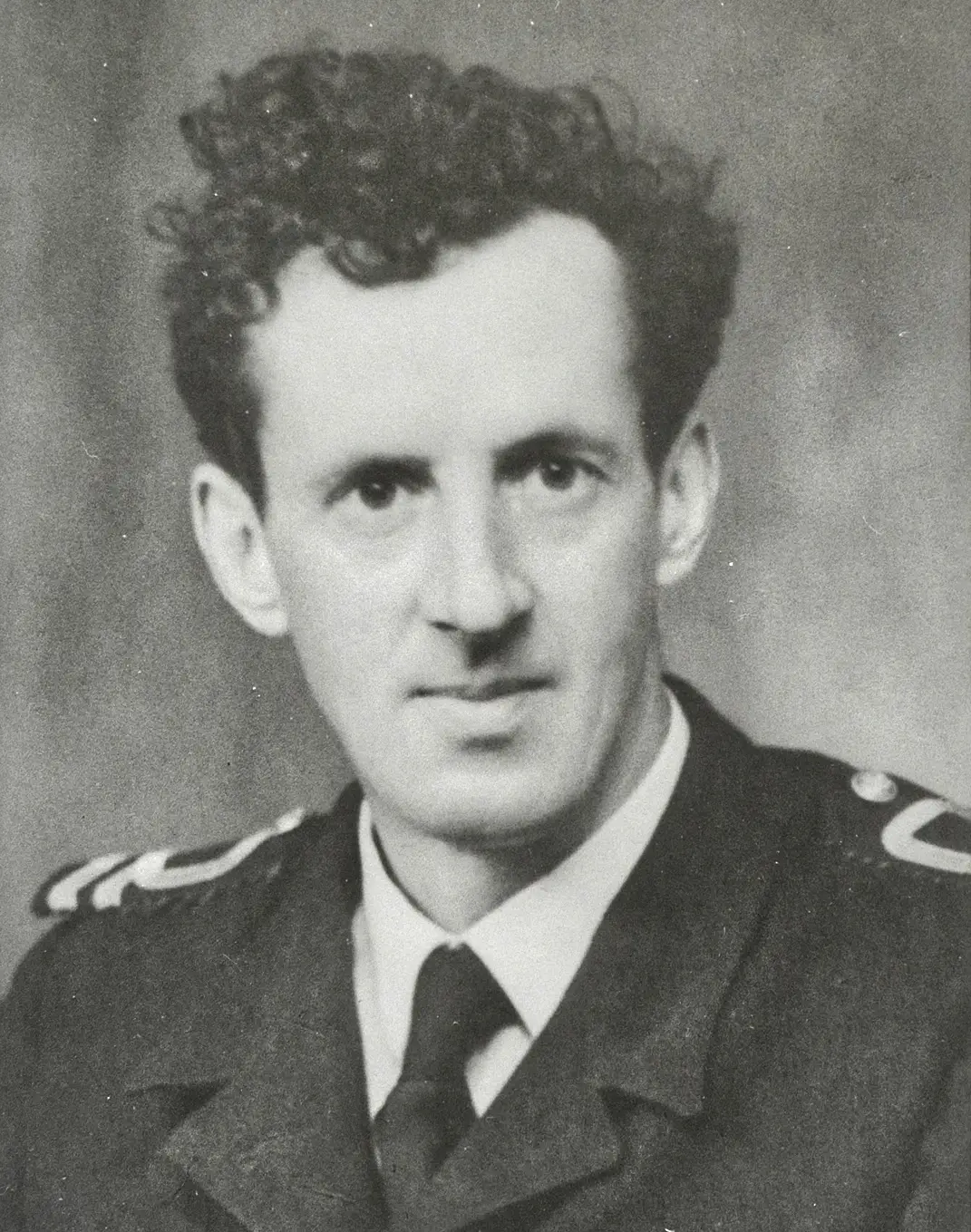
Thomas Hennell (1903-1945) was a British artist and writer whose work spanned rural scenes and wartime documentation. Born in Ridley Rectory, Kent, the son of a vicar, Hennell was educated at Oxford and went on to teach before devoting himself entirely to art and writing. His contributions to art and history are recognised in various collections, including the Imperial War Museum and the Tate Gallery and his life and works have been the subject of two books: one in 1988, “Thomas Hennell. Countryman, artist and writer” by Michael Macleod and a more recent one, in 2024 “The Land and the Mind” by Jessica Kilburn.
Thomas Hennell was born in April 1903, the son of the Vicar of Ridley and was brought up in the Rectory. The rural settings of Ridley, Hodsoll Street and Stansted deeply influenced his artistic themes. Looking back in 1936, he wrote of the Rectory:
“Our home stood far from the turnpike, by lanes which turn and twist
Nor often came there neighbours, nor were neighbours missed:
Not easy was the wayward road to find
Paved with round-rusted flints; time out of mind
By horseshoes hammered…: “
As a young adult, he worked as a teacher but left the profession to focus on his art and writing. His first major book, “Change in the Farm,” published in 1934, combined his illustrations and prose to capture the transformation of British agriculture during the interwar period.
He had a deep love and knowledge of the countryside, and he cycled great distances in England, Wales and Ireland, searching for scenes to paint. He must have been incredibly fit because he thought nothing of cycling to and from Bath and Sheffield, for instance, on an old-fashioned bicycle. He recorded a vanishing rural society as farming methods used for centuries died out or became scarce due to mechanisation and social change. Hennell was also interested in the way of life of the craftsman, and his drawings and paintings show wheelwrights, blacksmiths, thatchers, ladder-makers, lace-makers, scythers and hedgers: these traditional country crafts were in decline, and Hennell wished to document them while he could. He painted in watercolours in an expressive style.
Unfortunately, he experienced serious mental illness, which was diagnosed as schizophrenia, and he spent the years from 1932 to 1935 in three different ‘mental’ hospitals, the Maudsley Hospital amongst them. In 1935, his father wrote to the last of these, Claybury Hospital, thanking them for his son’s “return to sanity”. Hennell’s friend, Edward Bawden, encouraged him to ‘centre and compose’ the experience of schizophrenia by writing about it, and Hennell’s remarkable illustrated account, The Witnesses, was published in 1938. Eric Ravilious, too, helped Hennell with his recovery, providing a series of wood engravings as illustrations for “Poems by Thomas Hennell”, published in 1936.
At the outbreak of war in 1939, Hennell wrote to the War Artists Advisory Committee, offering his services as an artist. From 1943, he was a full-time salaried war artist, serving in Europe and the Far East. His work during this period includes vivid depictions of military operations, soldiers in action, and the aftermath of battle. His ability to capture the human element in these scenes brought a unique perspective to wartime art.
He was in Java when he was captured by Indonesian nationalist fighters in November 1945.
Hennell was born in Ridley Rectory, and this was his home until his parents moved to Ash Rectory in 1912 after his father became the vicar of Ash in addition to Ridley. The Rector discouraged his children from visiting the local village school. Its pupils had regular checks for lice and nits and were made to undress for inspection, which was embarrassing since rural poverty had reduced some to wearing jumble-sale cast-offs, or less. Elizabeth Hennell has described one child who was found to have been sewn into a makeshift garment of old muslin curtains. Here are the actualities. There is a tendency to idealise the country life of the past, but the facts are often unattractive.
During his young years at Ridley, he was tutored by Mary Cronk, the 26-year-old daughter of the Reverend Arthur Cronk, vicar of Stansted. She cycled daily from Stansted, arriving after breakfast and leaving after lunch with the family. He wrote a poem called “Lessons’ about this time. This is the first stanza:
ERE six years old I learned to write and spell
And lessons took from neighbour parson’s daughter
Who taught to reckon, cipher up, and spell
With book or slate and duster dipt in water.
She taught me much by verse or story’s means,
Whose images put life in local scenes.
Through his Governess, he became friends with her father, the Rector of Stansted, the Reverend Arthur Cronk. It seems from his poem, “Preparatory Absence from Home”, that he moved to Stansted Rectory to continue his education.
Another poem, ‘Conversation’, talks about Rector Cronk and the story of the day it rained fish in Stansted.
NOR Would I fail to thank this Doctor Kerr 1
My teacher’s father, and a white-haired sir,
Plain-spoken and most genial company:
With whom I trudged the long, wet-flinted lanes
Below the ash trees’ back-blown, whitened fronds;
By rabbit-riddled slopes, and upland ponds.
Note: Doctor Kerr was in reality the Reverend Arthur Round Cronk, Rector of Stansted from 1898 to his death in 1918, aged 75.
Another of Hennell’s poems, seemingly written in 1930, describes Stansted Rectory (called Hillstead in the poem). It tells the tale of Rev Cronk losing a key in the churchyard, being locked out of the Rectory, and later finding it under the yew tree.
After Hennell’s discharge from the hospital in 1935, he moved into Orchard Cottage in New Street Road, Hodsoll Street, which was just across the fields from Ridley Rectory. The house had been left to his father by an elderly parishioner, and Thomas lived there for the rest of his life.
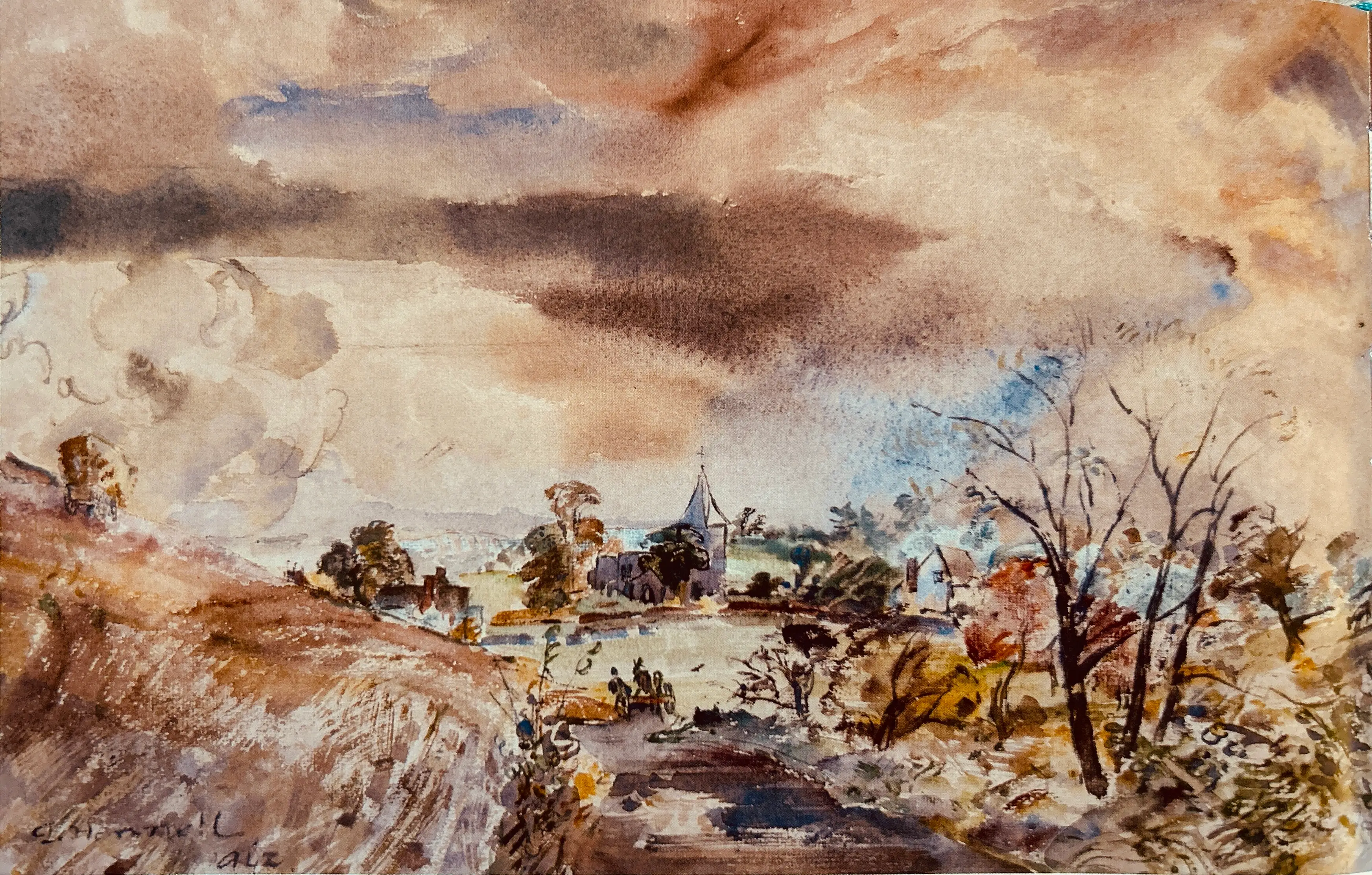
In 1942, he painted a view of Stansted, and his close friend Vincent Lines also sketched St Mary’s church on one of his many visits to Orchard Cottage.
He was a member of the Royal Watercolour Society and exhibited in the New English Art Club. A number of his works are held by the Imperial War Museum and the Tate and are also part of the Ministry of Defence art collection. As an author, he wrote books on windmills, his mental illness, country crafts and, in 1936, The Oxford University Press published a volume of his poetry called ‘Poems by Thomas Hennell’.
Bibliography
1934: Change in the Farm
1936: Poems – with wood-engravings by Eric Ravilious
1938: The Witnesses
1943: British Craftsmen
1947: The Countryman at Work
1947: Six Poems – privately printed at Tunbridge Wells School of Arts and Crafts
Hennell provided illustrations for
1939: A Countryman’s Journey by H.J. Massingham,
1939: Country Relics by H.J. Massingham,
1940: Chiltern Country by H.J. Massingham,
1943: English Farming by J.Russell,
1943: The Land is Yours by C.H. Warren,
1944: Miles from Anywhere by C.H. Warren,
1944: Farms and Fields by C.S. Orwin
1946: The Natural Order – Essays in the Return to Husbandry by H.J. Massingham (with Philip Mairet, Lord Northbourne, the Earl of Portsmouth)
1946-49: Recording Britain, Volumes 1,3 & 4 by A.Palmer (Editor),
1948: The Windmills of Thomas Hennell by Alan Stoyel
Tragically, Hennell’s life was cut short in 1945 when he was captured and killed by Indonesian nationalist fighters during the Indonesian National Revolution. Despite his early death aged just 42, Hennell left behind a significant body of work that continues to be celebrated for its historical value and artistic merit. His rural scenes and wartime illustrations offer a poignant and insightful view into the British countryside and the human side of war.
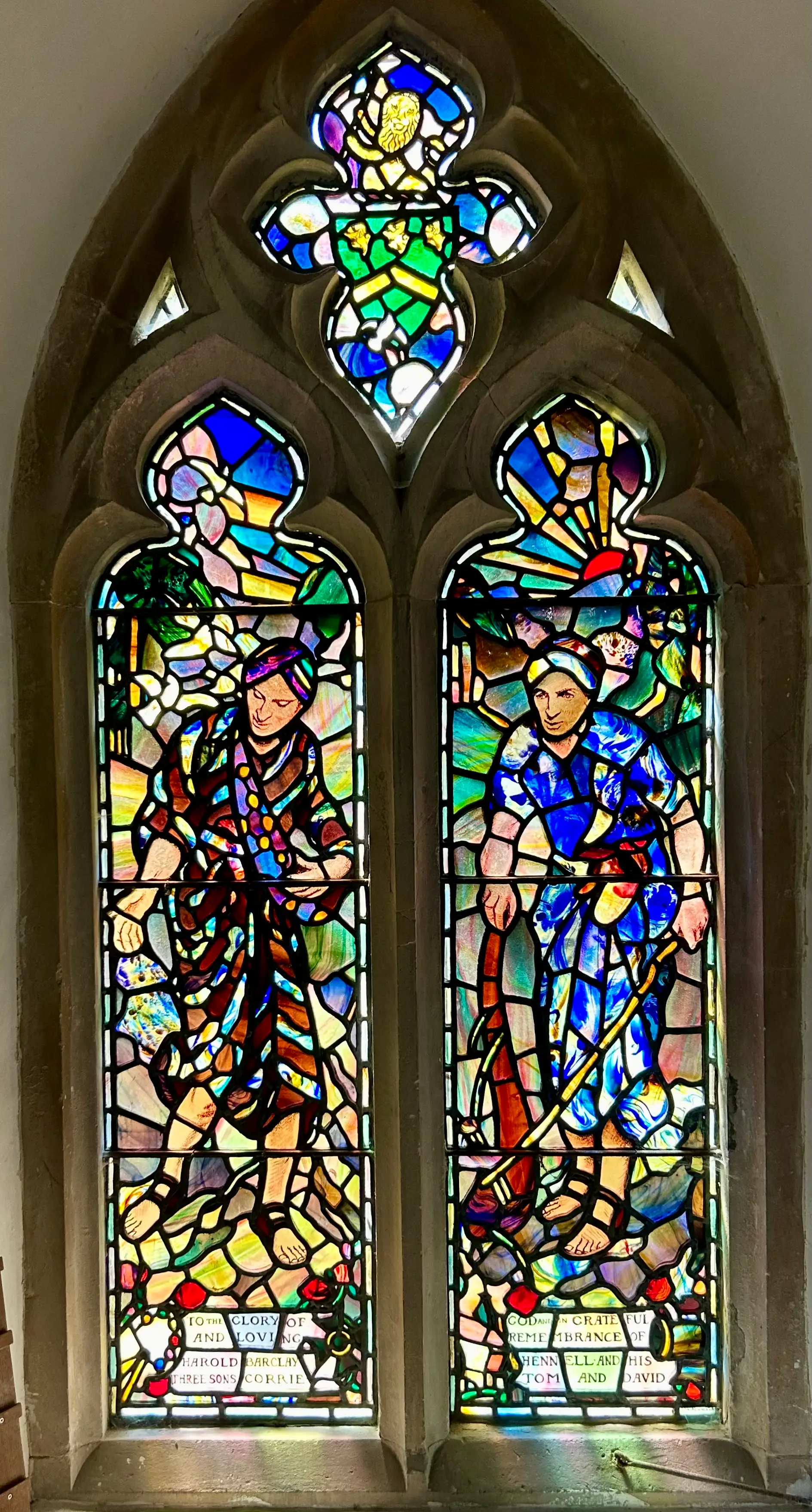
He has had his life and work commemorated, not only in the family stained glass window in Ridley church, but in two detailed books on his life as a countryman, author and artist; one called “Thomas Hennell. Countryman, artist and writer” by Michael Macleod and the other “Thomas Hennell. The Land and the Mind” by Jessica Kilburn. The former book was written after the author studied painting at Hastings School of Art in the early 1950s, where the principal, the artist Vincent Lines, who had been one of Hennell’s closest friends, introduced him to the artist’s work.
To assist his father, who was in his 70s and in failing health, Hennell had become a lay preacher and regularly took Sunday services in Ridley church. After his death, two people who had known him well described him as “having the heart of a child and the wisdom of a sage” and “he was an extraordinary man: the only person who gave me a feeling that he had a wonderful genius”.